
Treatment of mold and micro-organisms — seascape, oil on canvas
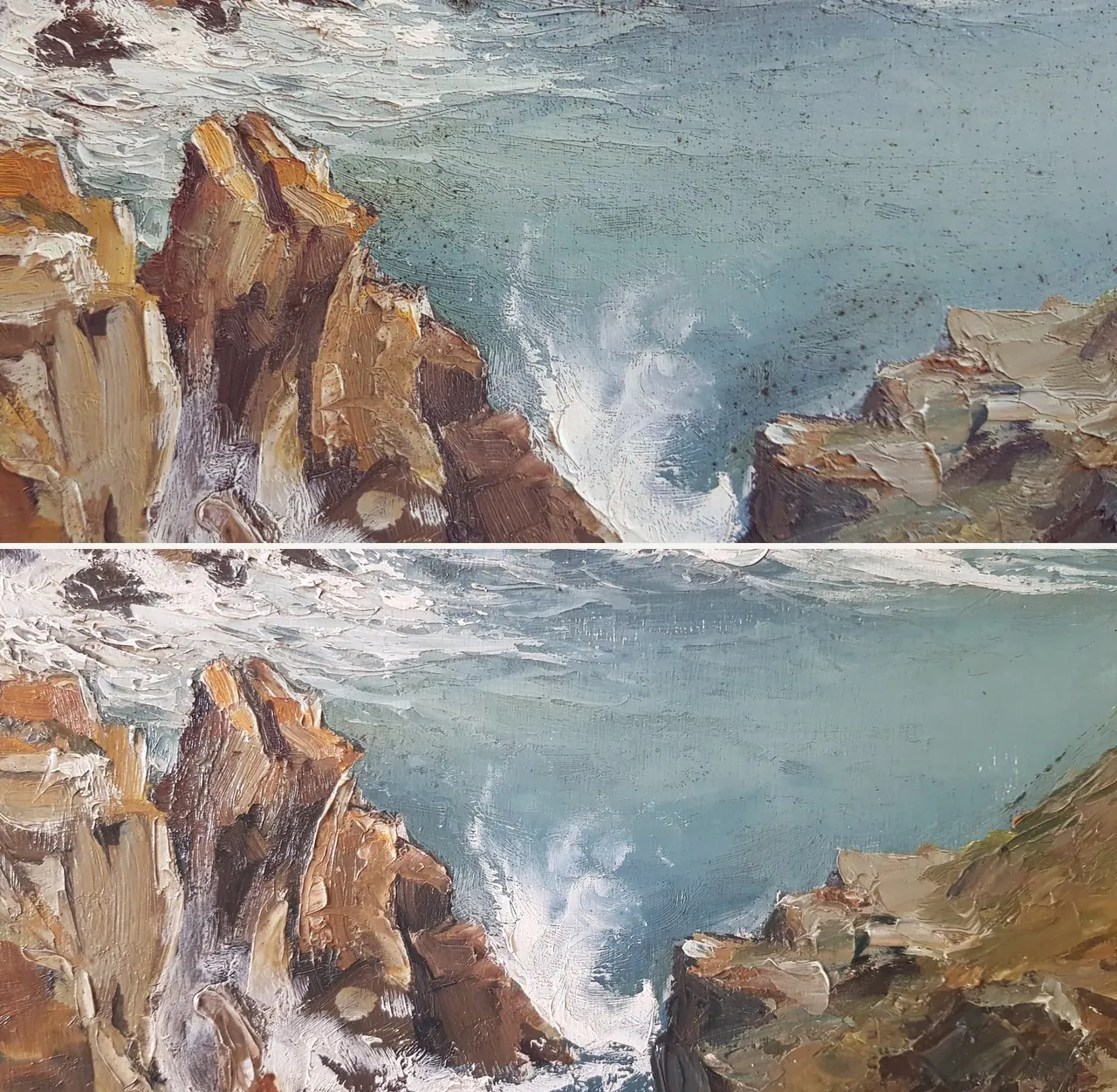
A scatter of black specks across the sea and the sky: the damp of the place it was kept in did the rest.
The photographs
The treatment
A painting deteriorates first of all through the place where it is kept. Damp finds its way in — a cold wall, a cellar, an attic, a room that is never aired — and a few weeks are enough for growth to become exponential. On this seascape, micro-organisms had formed a scatter of black specks across the whole of the sky and the sea, where the paint is smoothest.
The species involved are beyond counting: some 155,000 species of fungi have been described to date, out of an estimated total of 2.5 million. On historical wall paintings alone, a 2022 study recorded 260 species, belonging to 173 genera. Each feeds on whatever it finds: the glue of the ground, the binder of the paint layer, the varnish, or simply the dust settled on the surface.
The stain is never treated on its own: the whole work is treated. For a canvas, that means the reverse and the stretcher as much as the face, the ground, the paint layer and the varnish — and sometimes its removal. If the work is framed, the frame and the glazing are treated with it: to leave the wood or the reverse contaminated is to guarantee that it all begins again.
These are remedial care, carried out at À L’Atelier. They stop where preventive conservation begins, and that belongs to the owner: keeping the work away from cold walls, airing the room, avoiding sharp swings in humidity. A work that is treated and then returned to the same place will be contaminated again.
The stages of the treatment
- 01Condition report, examination of the face and the reverse under raking light
- 02Tests, then treatment of the micro-organisms across the whole work
- 03Treatment of the stretcher, the frame and the glass when they accompany the work
- 04Surface cleaning, then treatment of the varnish according to its condition
- 05Preventive conservation advice given with the work
In brief
- Material
- Painting
- Condition treated
- Mold and fungi
- Place
- À L’Atelier, 28 rue Traversière, Paris 12ᵉ
The condition report and the estimate are free of charge at À L’Atelier and commit you to nothing. One call is enough to find out what can be done.