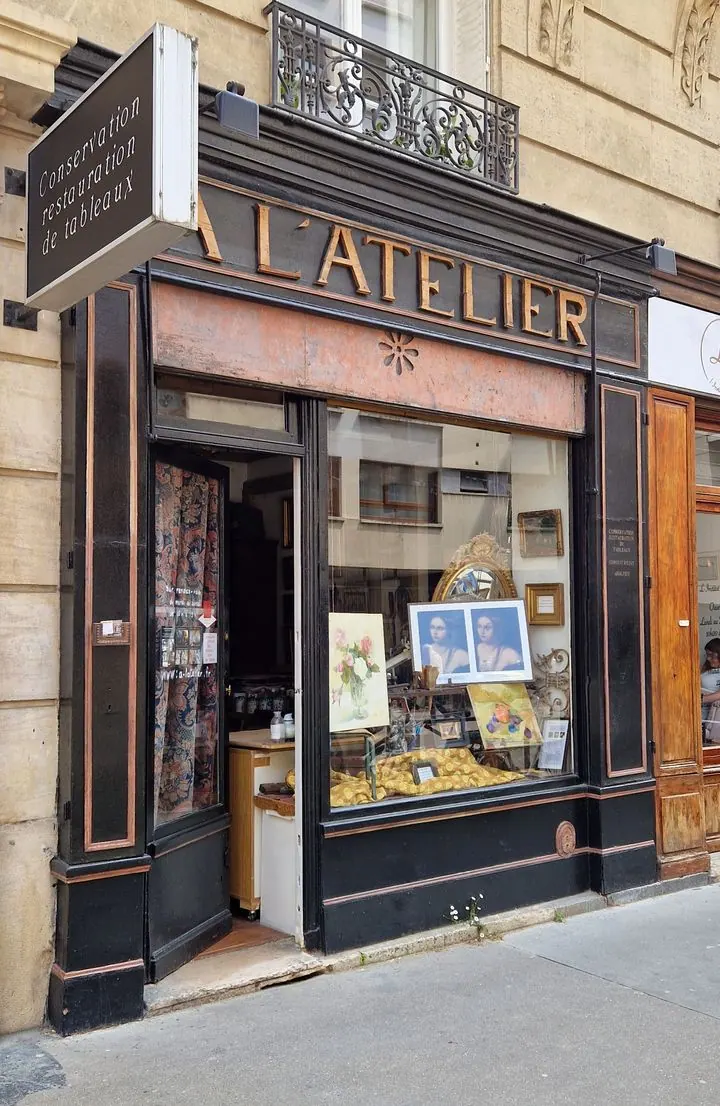
Old master, modern and contemporary paintings, sculpture, icons, frescoes, gilding and frames.
28 rue Traversière, Paris 12th · By appointment
Before · AfterÀ L’AtelierConservation & restoration of paintings, of sculptures and works of art28 rue Traversière, Paris 12th
Before
After
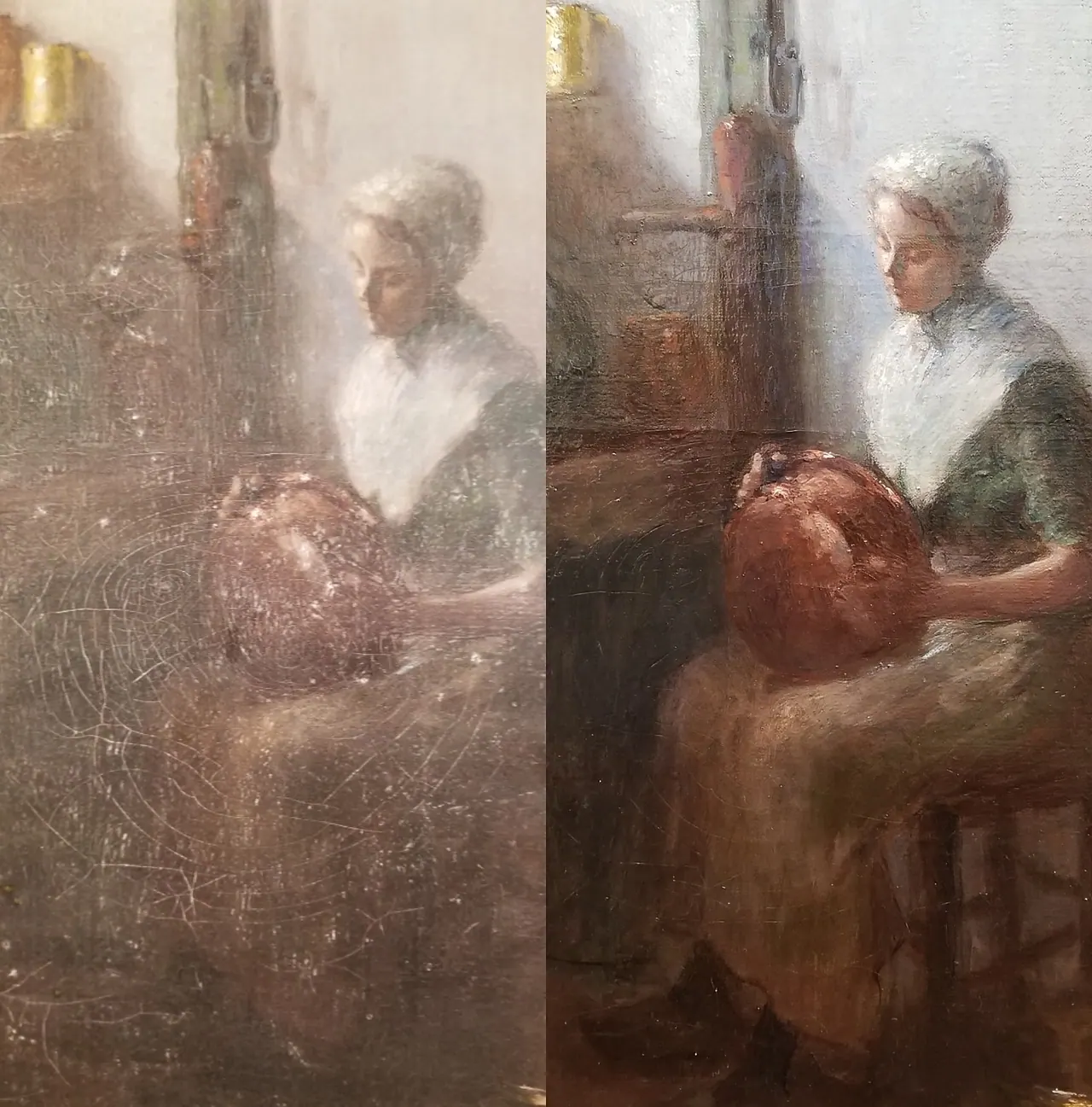
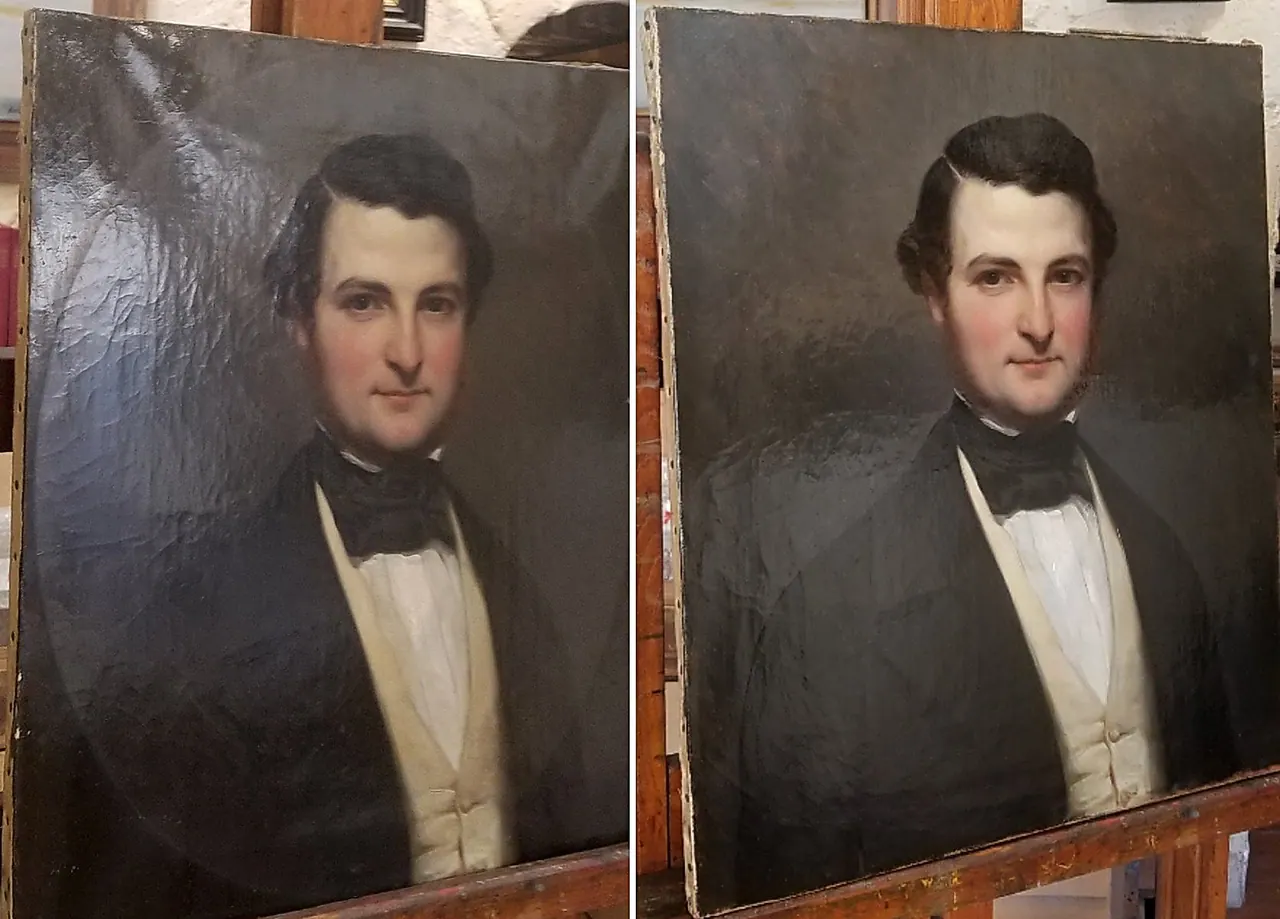
Reduction of an oxidised varnishThe varnish had turned a blue-grey and made the bouquet of roses disappear. Reduced area by area, with no overpainting.
Before
After
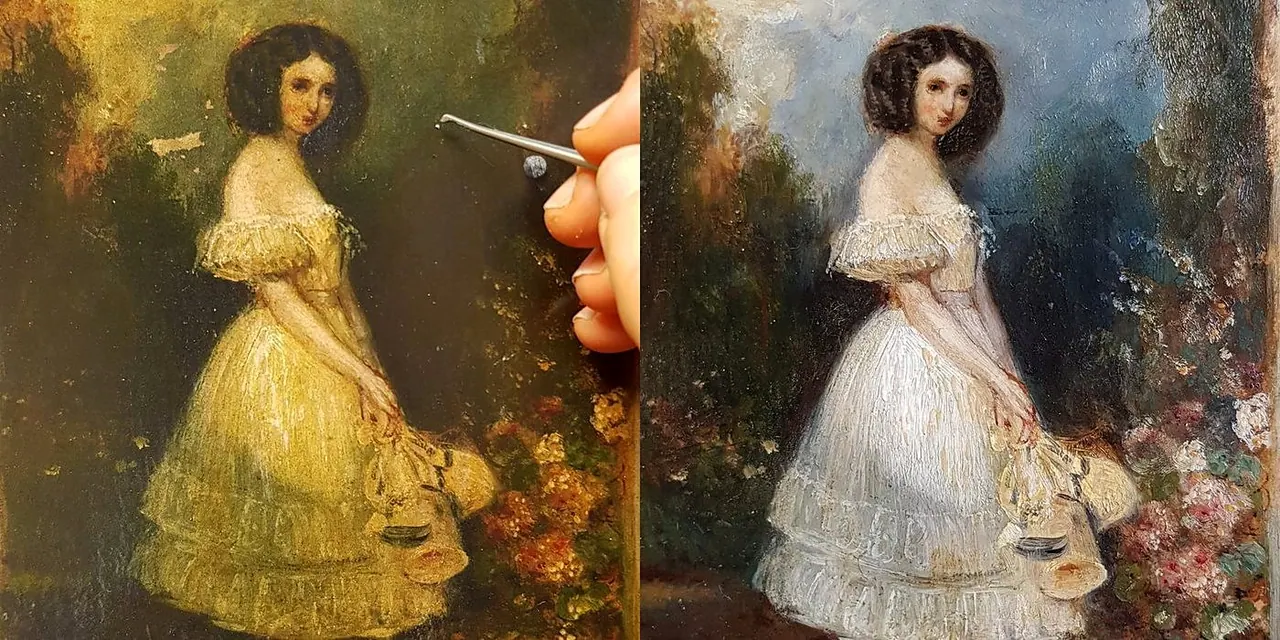
Re-fixing and reintegration of the colours within the cracksThe flaking is consolidated one piece at a time, and the colour is then reintegrated within the cracks, with a fine brush, never straying onto the original.
Before
After
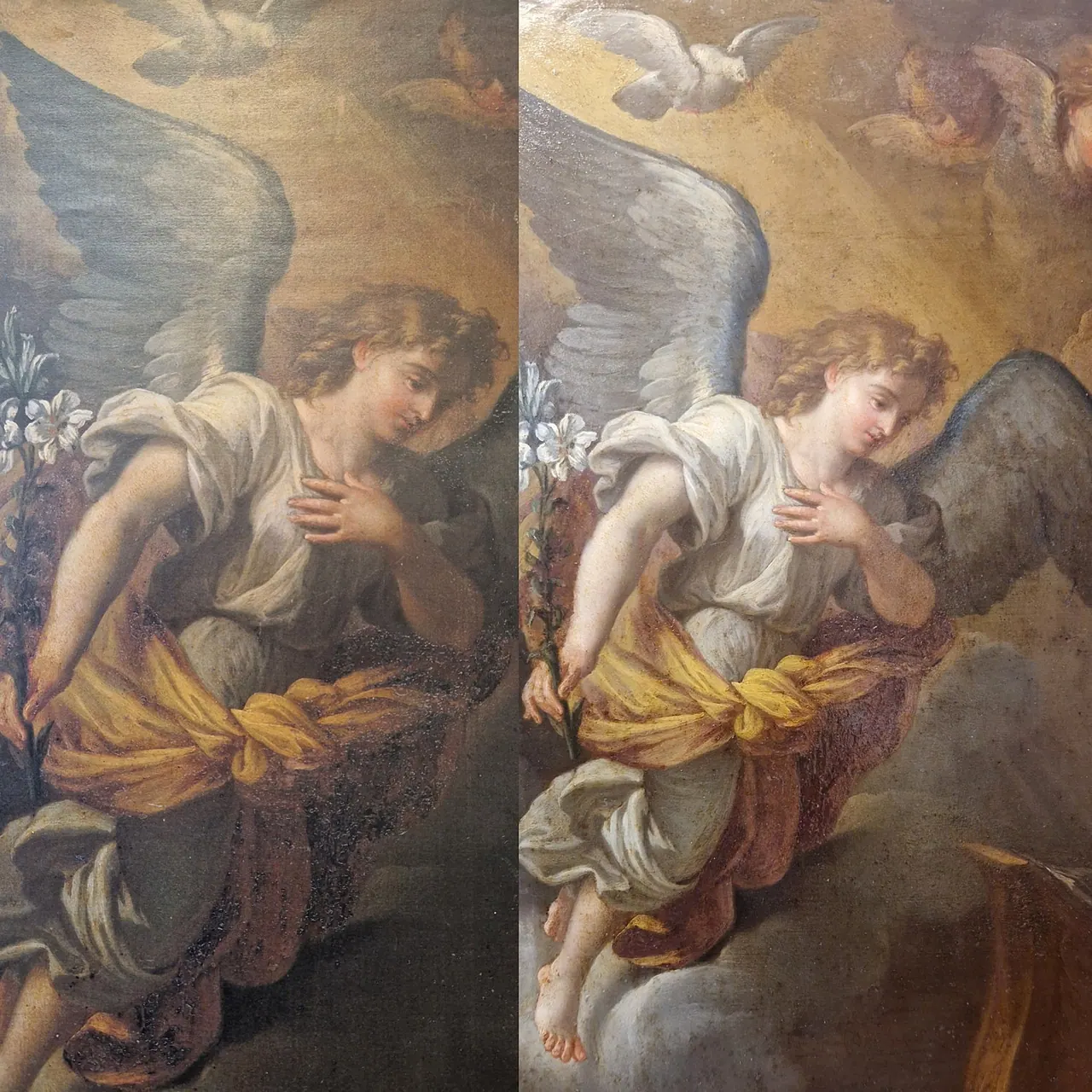
Consolidation, lining and treatment of the tearThe canvas is consolidated from the reverse — lined where its condition requires it — and the tear is then treated and the loss reintegrated, with no repainting beyond the loss itself.
Before
After
Making good the losses and illusionistic retouchingThe lifting paint layer had left losses on the face and in front of the mouth. The material is brought back to level, then retouched with a fine brush until it disappears to the naked eye.
Before
After
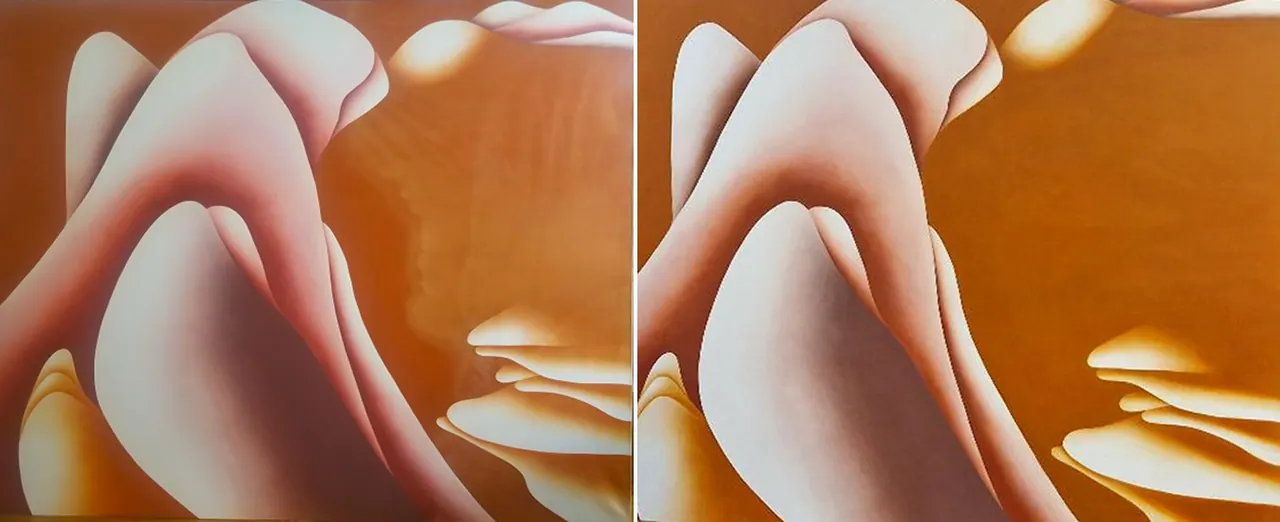
Broken ivory — securing and making good the lossesOne of the animal's legs, and the leafy branch it carries in its mouth, had broken away. Each fragment is secured along its break; the missing parts are made good and toned to match the colour of the old ivory.
Giving the work back its light, without adding anything to it.
Studio for the restoration of paintings and works of art in Paris
Your work is unique. It carries its own history and your memories within it. At À L'Atelier, everything is done to preserve it and to hand it on in better condition.
In the service of heritage and historic monuments for twenty-six years, the studio offers its expertise for the conservation and restoration of your works of art: old master, modern and contemporary paintings, icons, frescoes, sculpture in marble, terracotta, plaster, wood and ceramic, frames and gold-leaf gilding.
What sets us apart: a wide range of techniques and the great number of treatments gathered over the years. Precision of hand and constantly renewed research give each work a solution of its own — the care that is most exact, most lasting and most faithful to what the work is.
To have a painting or a work of art restored in Paris, the studio is in the 12the,
at 28 rue Traversière.
Isabelle Pitre, Maître Artisan, a state-qualified conservator of paintings and works of art, receives you by appointment to identify the alterations of the work with you and to determine the kind of intervention required — the treatments, the materials and the time needed for its safeguarding, its conservation and its restoration.
To answer the object on its own terms and to preserve its history, weighing each gesture and each technique with judgement: a delicate path, and one that only long experience allows you to master. Safeguarding, conserving and restoring call for historical, scientific, technical and aesthetic knowledge alike.
01Drawing up a condition report
02Defining precisely the methods and the procedures to follow
03Using the standard tools — tests, analyses, black-and-white and colour photography, ultraviolet and infrared lamps, X-radiography, scanning — in collaboration with laboratories and experts
In preserving and restoring your works of art, we share responsibility for an irreplaceable cultural inheritance.
Safeguarding · Conservation · Restoration
Three distinct fields, one and the same craft.
In everyday speech, 'restoration' is used for the whole of the work, whereas the word names only one part of it. The three disciplines are not interchangeable, and the order in which they are taken is never a matter of indifference.
01 — Safeguarding
Putting the work out of danger.
These are the first measures of all: protecting the work and giving it the emergency care its condition demands. Stopping whatever is destroying it — damp, flaking paint, insects, a failing support — before its appearance is even considered.
02 — Conservation
Keeping what the work carries.
It is preventive: to stabilise the material, preserve it and slow its deterioration — consolidation of the support, surface cleaning, control of the conditions in which the work is kept — without altering its historical state. Its aim is material permanence: to maintain the properties and qualities of the work — its technique, its traces, its inscriptions — so that it may be passed on with everything it carries. Nothing that makes its history may be erased.
03 — Restoration
Giving the work back its legibility.
This is direct intervention, the province of the aesthetic: restoring the original visual appearance — retouching a loss, making good a missing element, giving the whole its continuity again. It comes only once the work has been stabilised, and it serves legibility. A stage that has meaning only if the first two have been carried out.
The studio works on these three fields. It is this command of the whole that guarantees respect for the work and its safe passing on — and that is what the line beneath the studio's name has always said. In short: conservation stabilises the material, restoration restores its appearance and its form.
Portrait
Isabelle Pitre
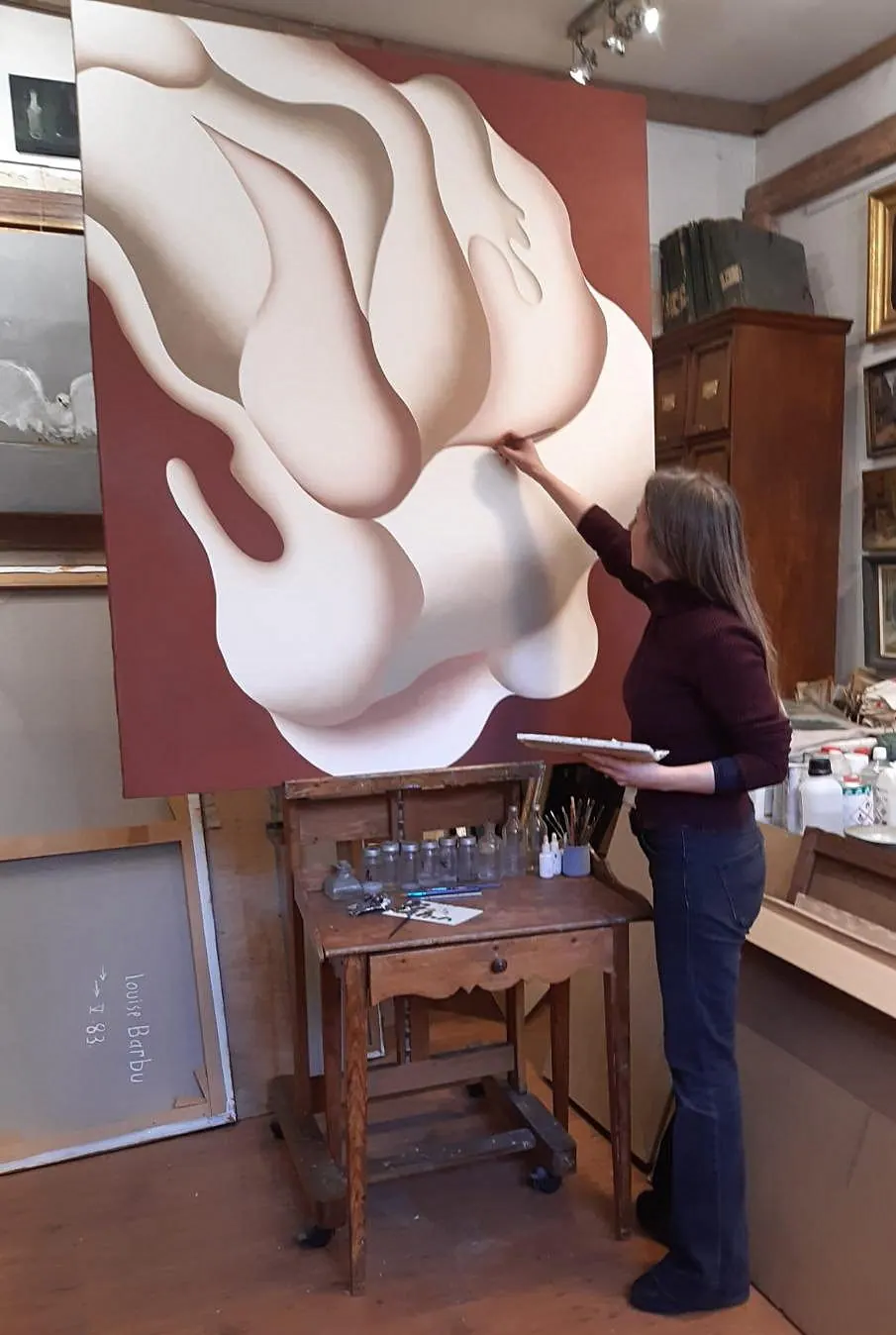
Work on a canvas by Louise BarbuA delicate technique and touch on an ultra-matt, powdery surface.
Maître Artisanin art crafts
Maître Artisan for more than twelve years, Isabelle Pitre has run her restoration studio in Paris, in the 12th arrondissement, for twenty-six years. She trained at the École du Louvre,
then holder of a Master's degree in the conservation and restoration of works of art (École de Condé), she works on paintings, sculpture, icons, frescoes and painted schemes, for institutions, places of worship and private collections.
Daughter of the painter Jeanon, she grew up in the studio of her mother — a restorer who worked alongside Majorelle and ofYves Brayer,
was the right hand ofÉdouard Mac-Avoy and taught painting for thirty-eight years. At her side, Isabelle Pitre learnt early the precision of the hand and the demands of the eye, copying works by the masters from her teens onwards.
Precise and exacting, she has restored more than 3,000 works over the course of her career,
including 200 works by masters — painting and sculpture — for museums, collectors and galleries, together with works entrusted to her through more than ten years of collaboration with the Lumière Technology laboratory.
The other side of her family — her father, her grandfathers, her brother and her sister — is scientific as well: engineers
and doctoral researchers, for whom nothing is asserted without being observed, measured and demonstrated. From this double descent —
the painter's hand and the method of the researcher — has come the DNA of her craft: the sensitivity to read a work, the rigour to treat it.
For conservation belongs to both worlds at once. It calls for a knowledge of materials and of the way they age, for identifying before intervening, for carrying out tests, for using only reversible products and for documenting every stage — and then, at the end of that protocol, for laying down by hand the one right tone, the tone that gives the work back its legibility without ever adding anything to it.
TrainingÉcole du Louvre — Master's in the conservation and restoration of works of art, École de Condé
TitleMaître Artisan for more than 12 years
StudioFounded 26 years ago, 28 rue Traversière, Paris 12th
WorksMore than 3,000 restorations, across every technique
Passing onTeaching of oil painting and drawing · lectures (Drouot, Corvisart, Musée de Fougères, Saint-Julien-le-Pauvre) · co-author of a book on the iconostasis of Saint-Julien-le-Pauvre
Restorations
Restoration case studies.
Twenty-six years of real commissions, photographed as they arrived at the studio and as they left it. Open the section that matches your work.
Choose a speciality
Easel paintings: oxidised varnish, craquelure, tears, flaking, losses, mould and deformation of the support. Monumental works have a section of their own.
Reassembly of fragments along their break, filling of losses, reintegration of polychromy and gilding — and, where the original is lost, the creation of the missing parts.
Dusting, treatment of tears and stains, re-tensioning — without ever fixing the pigment, which would alter its nature.
Wood moves and splits, varnish turns brown: consolidation of the support, reduction of the varnish, reintegration of the drapery, the flesh tones and the gold grounds.
Resin, vinyl, mixed media: each material dictates its own adhesive, its own retouching and its own limits. The treatment remains reversible.
A painting restored in a damaged frame is still a damaged work. Impressions of lost mouldings, reintegration, gold-leaf gilding and patination.
Ceramic breaks cleanly: the fragments are rejoined along the break with a reversible adhesive, the losses are filled, and the retouching is then laid within the area of loss alone — never over the original glaze.
Ivory moves with humidity and breaks without warning. Detached elements are secured along their break, and lost parts are made good in a compatible material, toned to the ivory beside them.
A monumental work does not leave its setting: it is the studio that travels to it. Every retouch must read correctly several metres below and at thirty centimetres alike.
Refine this section
Treatment of an overly glossy, opaque varnish, and of a yellowing varnishportrait of a young girl, late 17th century
Yellowed varnish
Before / After
The varnish veiled the whole in a blue-grey: the bouquet of roses had disappeared.
Yellowed varnish
Treatment of an over-glossy, opaque varnish and of a yellowing varnish — portrait of a young girl, late seventeenth century
Treatment of an overly glossy, opaque varnish, and of a yellowing varnish. The varnish veiled the whole in a bluish grey and had made the bouquet of roses in her hand disappear, along with the foliage and the flowers on the ground.
After solubility tests, the varnish is reduced area by area: the flesh tones, the blues of the dress and the roses recover their value, with no overpainting whatsoever. The excessive gloss is brought back to a just saturation, the one the work had to begin with.
Treatment of an opaque, blanched varnish (blanching), with damp presentoil on canvas
Opaque, blanched varnish
Before (above) / After (below)
The opacity of the varnish made the work and its original colours impossible to read.
Opaque, blanched varnish
Treatment of an opaque, blanched varnish, with damp present — oil on canvas
Treatment of an opaque, blanched varnish — blanching —, in the presence of damp. Damp had penetrated the varnish and turned it white. The milky veil was such that the work could not be read at all: the face could barely be made out, and the hair and the mouth had lost all colour.
The blanching is treated first, then the varnish reduced by degrees. The flesh tones, the golds of the hair, the red of the mouth and the browns of the background recover their original colours.
The network of cracks, however, remains: it belongs to the age of the work and is not removed.
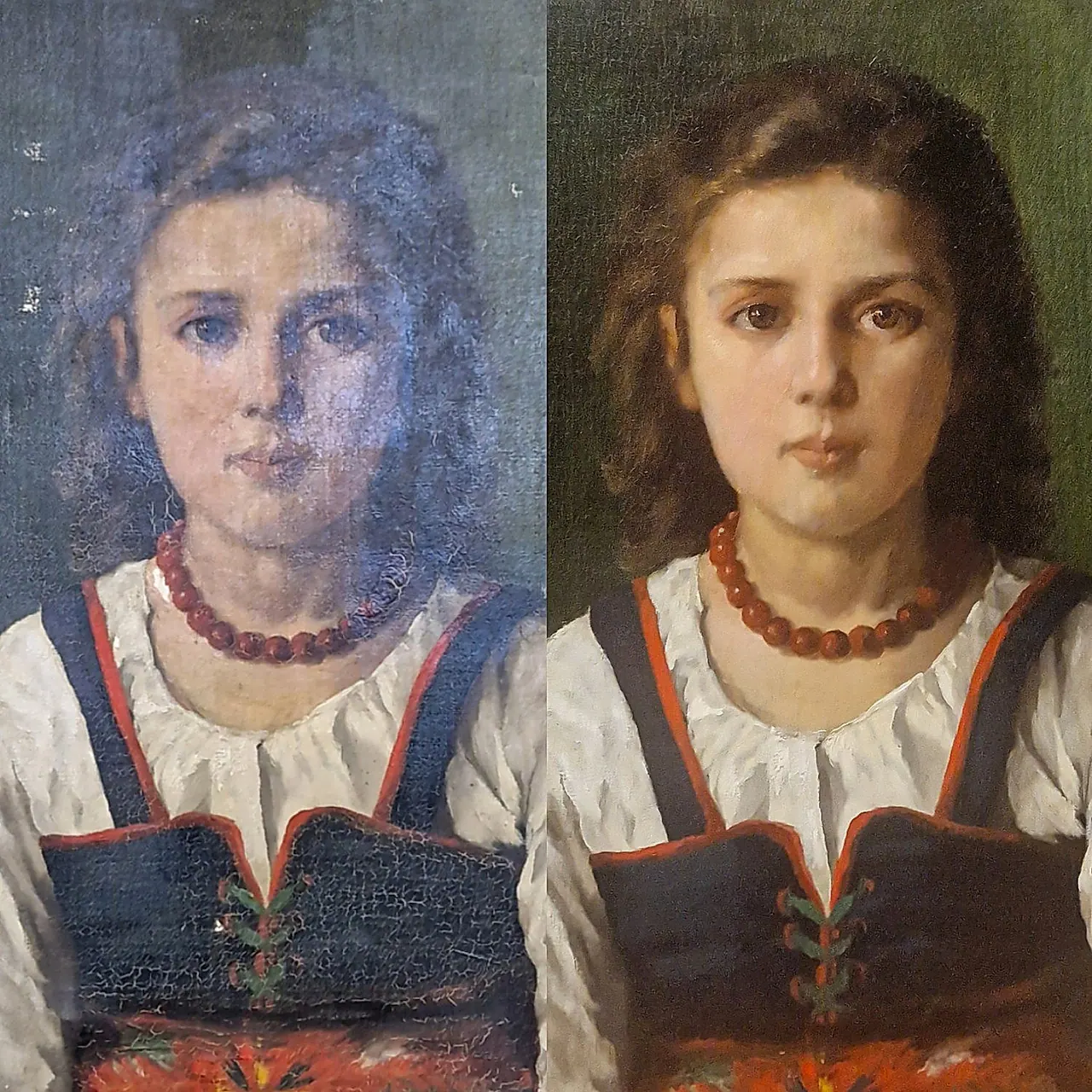
Treatment of the varnish and of a network of craquelureportrait of a young girl with a coral necklace
Yellowed varnish
Before / After — treatment of the varnish and the craquelure
A bluish veil across the whole surface, and craquelure reaching into the face.
Yellowed varnish
Treatment of the varnish and of a network of cracks — portrait of a young girl with a coral necklace
Treatment of the varnish and of a network of craquelure. An oxidised varnish covered the work with a bluish veil; beneath that veil, a network of cracks ran across the whole surface — the face, the chemise, the bodice.
Consolidation comes before any cleaning: as long as a flake moves, nothing else can be undertaken. The cracks are treated one after another, and the varnish is then reduced in stages, after solubility tests.
The work recovers its values: the modelling of the face and the gaze, the brown of the hair, the red of the coral necklace and the embroidery of the bodice.
Reduction and treatment of the varnish on a canvascleaning and varnish removal
Yellowed varnish
Before / After
Dirt first, varnish afterwards — two operations that are never carried out together.
Yellowed varnish
Reduction and treatment of the varnish on a canvas — cleaning and varnish removal
Reduction and treatment of the varnish on a canvas. Each operation is carried out separately, and in this order: dusting of the surface, then removal of the surface dirt, then treatment of the weakened support, and and last of all the reduction of the varnish. Carrying out two of these operations at once would mean working on an unstable layer, and making the varnish answer for what belongs to the dirt — or the other way round.
Cleaning the varnish of a painting — or rather reducing it — must be done with great care and by a professional alone, to avoid over-cleaning and irreversible damage. Solubility tests are needed to establish which products are suitable.
The varnish of a painting can be kept if it is of good quality. Regenerating a varnish is possible. Cleaning the surface of the painting is sometimes enough.
Every painting calls for different products, according to the chemical, physical and mechanical make-up of the work itself. The skill of a Maître Artisan in the restoration of paintings lies in defining the right method and in matching precise gestures to appropriate materials.
The stages of the treatment
01Dry dusting of the surface, before any product is applied
02Removal of the surface dirt, after testing, without touching the varnish
03Treatment of the weakened support: re-fixing and consolidation
04Reduction of the varnish last of all, in stages and area by area
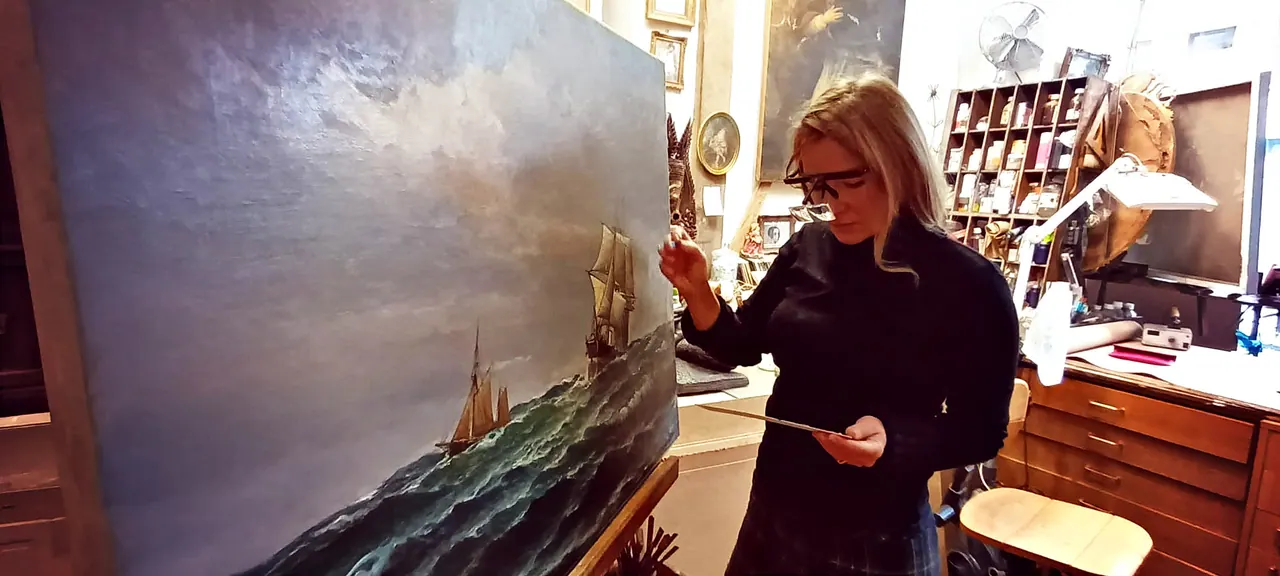
Treatment of old overpaint and reduction of the yellowed varnishharbour seascape
Yellowed varnish
Before / After
Old overpaint and varnish had closed the scene up: sky, water and figures could no longer be read.
Yellowed varnish
Treatment of old overpaint and reduction of the yellowed varnish — harbour seascape
Treatment of old overpaint and earlier restorations, and reduction of a yellowed varnish. As it aged, the varnish had turned brown and closed the work up: the sky was going brown, the water no longer returned the light, and the figures on the bridge and in the boat were disappearing into the dark mass.
The overpaint and earlier restorations, laid over the paint layer through the years, are identified and then removed: once taken down, they let the original material reappear, and it is reintegrated only where it is genuinely missing.
The varnish is then reduced in stages, after solubility tests, and never down to the paint layer. The work recovers its light: the trail of the sun on the water, the mills in the haze, the red ensign and the crew's clothing — everything the painting still held beneath the varnish.
Reduction of a very thick resinous varnishicon, Saint John slaying the dragon
Yellowed varnish
Before / After
An extremely thick resinous varnish, removed over several days: the gold ground reappears.
Yellowed varnish
Reduction of a very thick resinous varnish — icon, Saint John slaying the dragon
Icon painted in oil on panel, depicting Saint John slaying the dragon. It belongs to the first register, above the doors of the iconostasis in the church of Saint-Julien-le-Pauvre, in Paris.
It carried an extremely thick, resinous varnish that had no business being there. Removing that depth of varnish and its runs took several days of work. The work is shown before and after treatment: the gold ground reappears.
This work is a reproduction of a painting by Raphael. Reproduced by Daoud Corm, Lebanese painter of the 19th century, it shows the quality of its execution and points to the influence of the Italian school, acquired during his training at the Accademia di San Luca in Rome, under the painter Roberto Bompiani.
Re-fixing and treatment of the craquelureoil on canvas
Craquelure
Before / After
A network of cracks and an oxidised varnish had dimmed the scene beneath a grey veil.
Craquelure
Re-fixing and treatment of the craquelure — oil on canvas
Treatment of the craquelure on an oil on canvas. Craquelure in an oil on canvas is often a sign of the ageing of the varnish or of the paint layer, of a weakened ground — or of the absence of any ground — or again of a fragile support, whether through its own make-up or through knocks it has suffered.
Treating craquelure in a painting calls first for understanding where the cracks came from, and then for choosing the least invasive steps.
When a painting shows widespread flaking of the paint layer, consolidation becomes necessary: either by local injection, or across the whole surface, or from the reverse, or both.
Treatment of oxidation, removal of old overpaint and illusionistic reintegrationpaint on copper
Oxidation, paint on metal
Before / After — the angel with the lily, detail
The Annunciation to the Virgin Mary, painted on copper: the paint layer lifting and cracked, with old overpaint that had become visible.
Oxidation, paint on metal
Treatment of oxidation, removal of old overpaint and illusionistic reintegration — painting on copper
Treatment of oxidised pigments and old overpaint, on a painting on copper. The work represents the Annunciation to the Virgin Mary; the detail shows the angel holding the lily.
The paint had lifted and cracked, and the old overpaint, as it aged, had become visible: it read as dark patches over the original material.
The overpaint was removed first, then the oxidation treated — on copper, the paint layer and the metal do not age at the same rate, and it is the support that sets the terms.
The losses were finally reintegrated with illusionistic retouching: the dove, the ray of gold, the flesh tones and the drapery recover their legibility, with nothing added to the work.
Treatment of tidelines, stains and scratchesa large modern painting by Louise Barbu
Damp stains
Before / After — tidelines, stains and scratches treated
On a painting as smooth as this, with its continuous gradations, the slightest tideline is visible from the far end of the room.
Damp stains
Treatment of tidelines, stains and scratches — large modern painting by Louise Barbu
A large modern painting, by Louise Barbu. The canvas showed tidelines, stains and assorted scratches. On a painting as smooth as this, where one tone passes into the next without a break, the slightest tideline is visible from the far end of the room.
The treatment is carried out area by area, from the gentlest measure to the most committed, with tests beforehand: on these modern paints, thin and barely covering, over-cleaning would leave a mark more visible than the stain.
The scratches are then filled level with the surrounding surface and reintegrated. The gradations recover their continuity, and the background its unity.
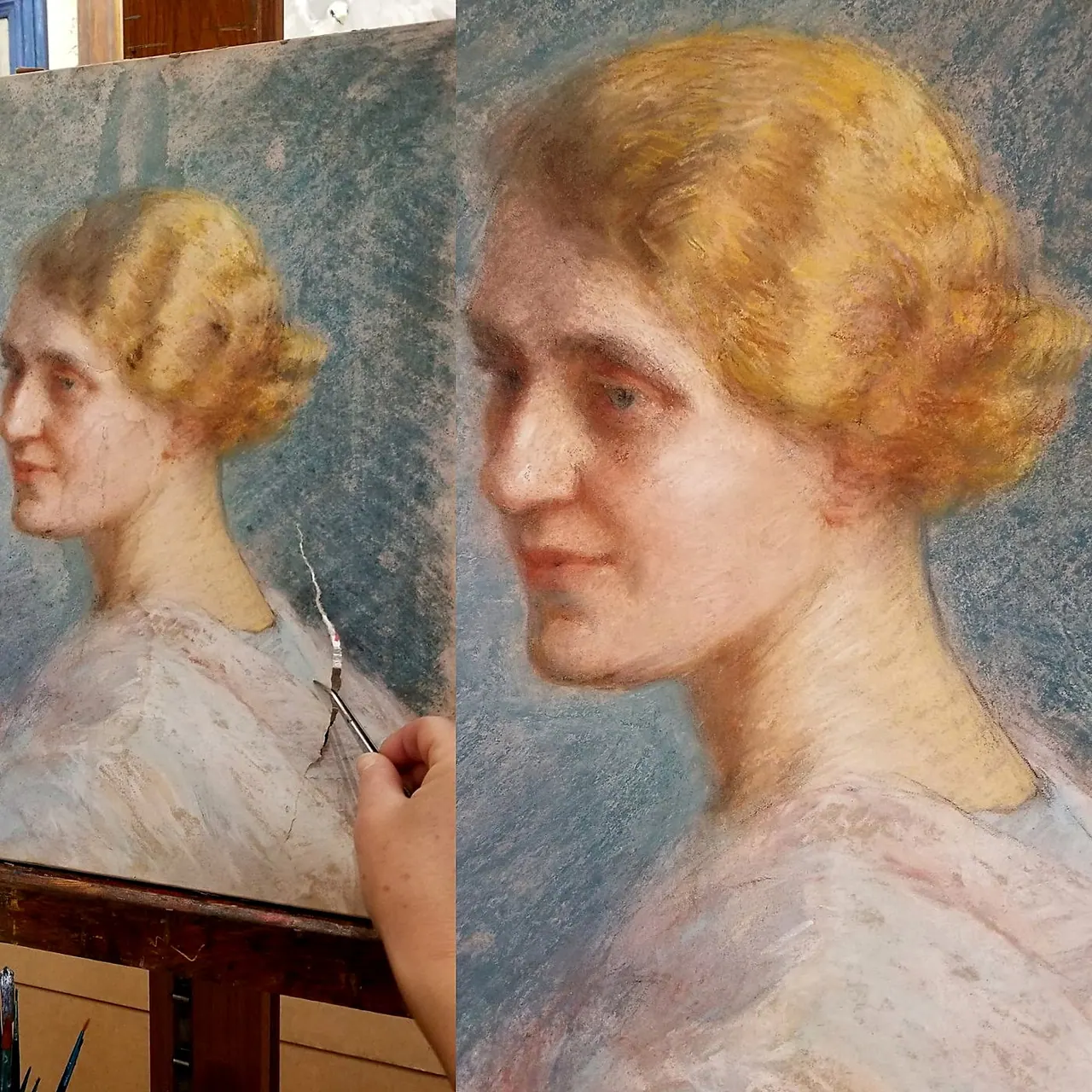
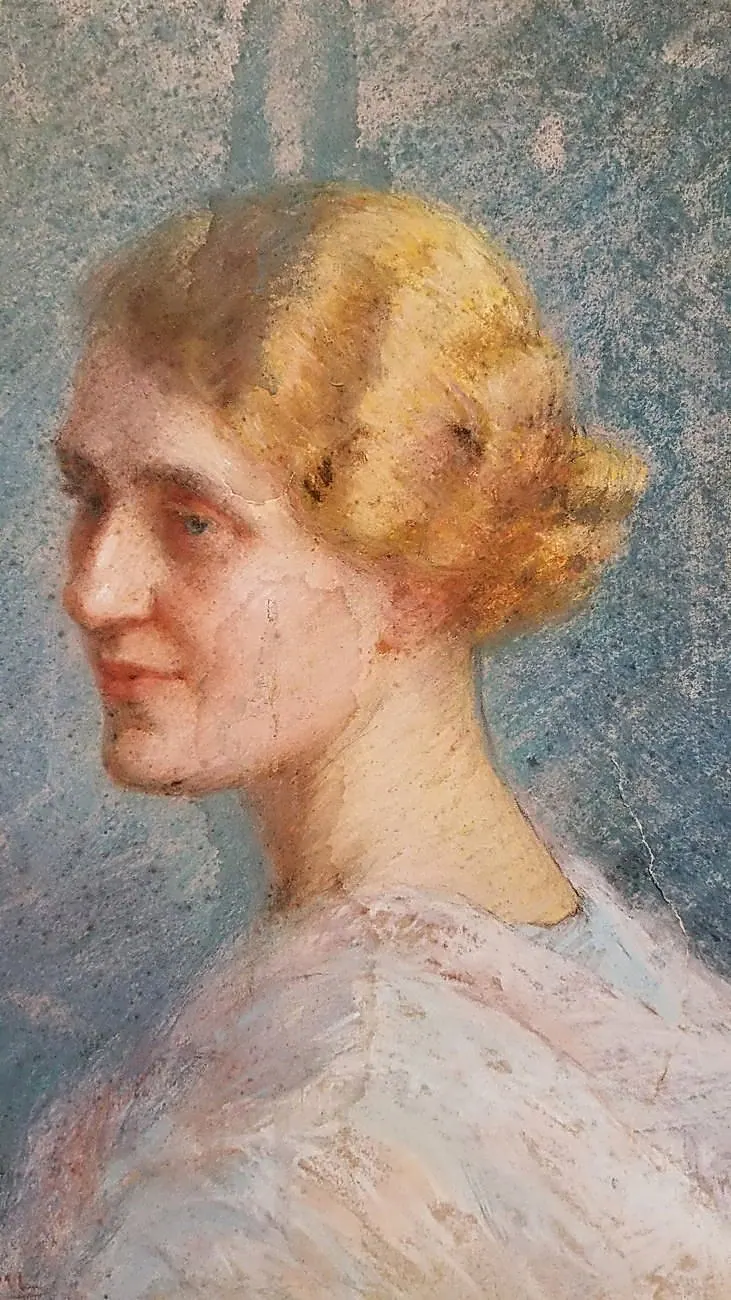
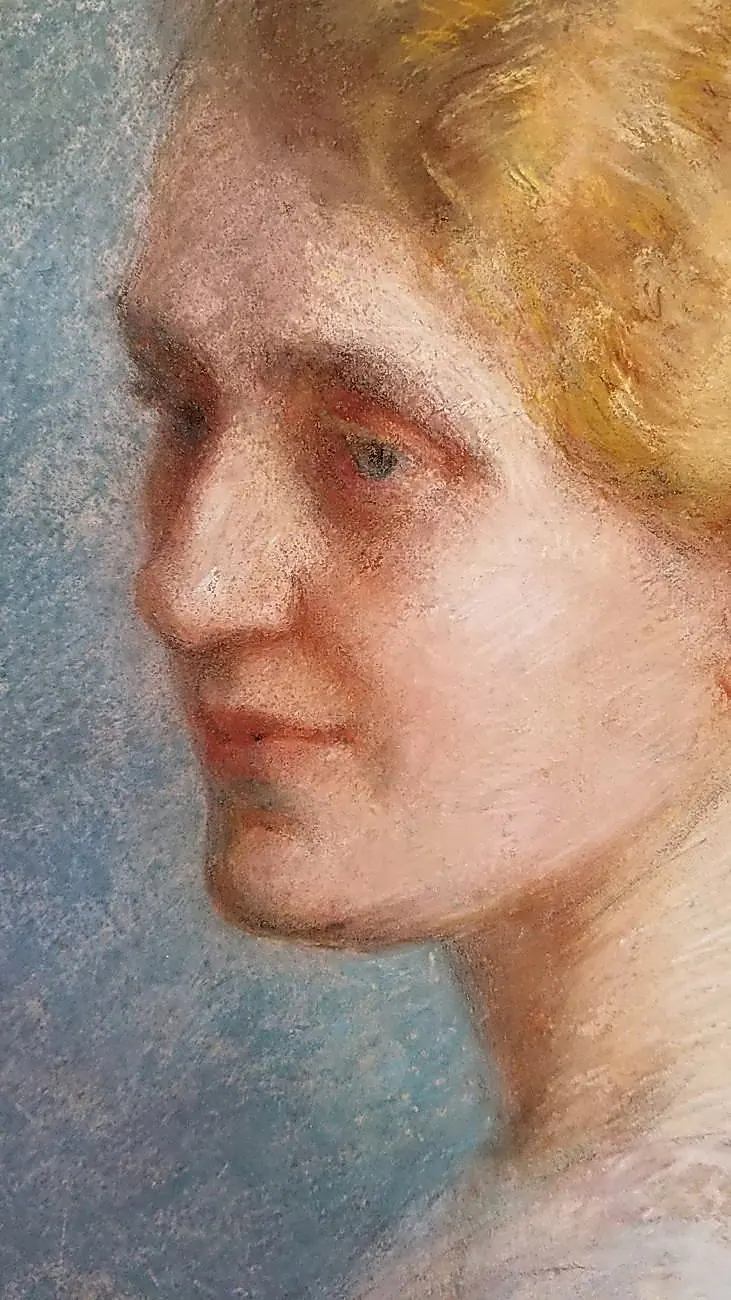
Treatment of a tear in paper, of stains and of tidelinespastel after water damage
Water damage
Before / After — the tear undergoing treatment
Before / After — detail of the face and the backgroundBefore — stains, tidelines and a tear in the paperThe tear in the paper, undergoing treatmentAfter — stains and tidelines resolved, tear closedAfter — detail of the face
Water had stained the sheet and weakened it to the point of tearing, at the shoulder.
Water damage
Treatment of a tear in paper, of stains and tidelines — pastel after water damage
Damp stains and a tear in the paper, following water damage. Water had migrated into the sheet: tidelines, foxing and a greyish veil over the blue ground and the flesh tones, and paper weakened to the point of tearing, here at the shoulder.
A pastel is not treated like a painting: nothing holds the colour in place. It rests on the grain of the paper alone, and the slightest contact takes it away. The whole treatment is therefore carried out without ever touching the surface — the work is done from the reverse, the sheet laid flat, the gesture guided with tweezers under the binocular microscope.
The tear is closed from the reverse, fibre by fibre. The stains are drawn out gradually, by indirect contact and controlled drying, without ever wetting the coloured surface.
A pastel is never fixed. A fixative would make the surface more stable, but it would extinguish the velvety bloom that is the whole point of the technique — precisely what the artist was after. The background recovers its blue, the skin its light, and the work keeps its powder.
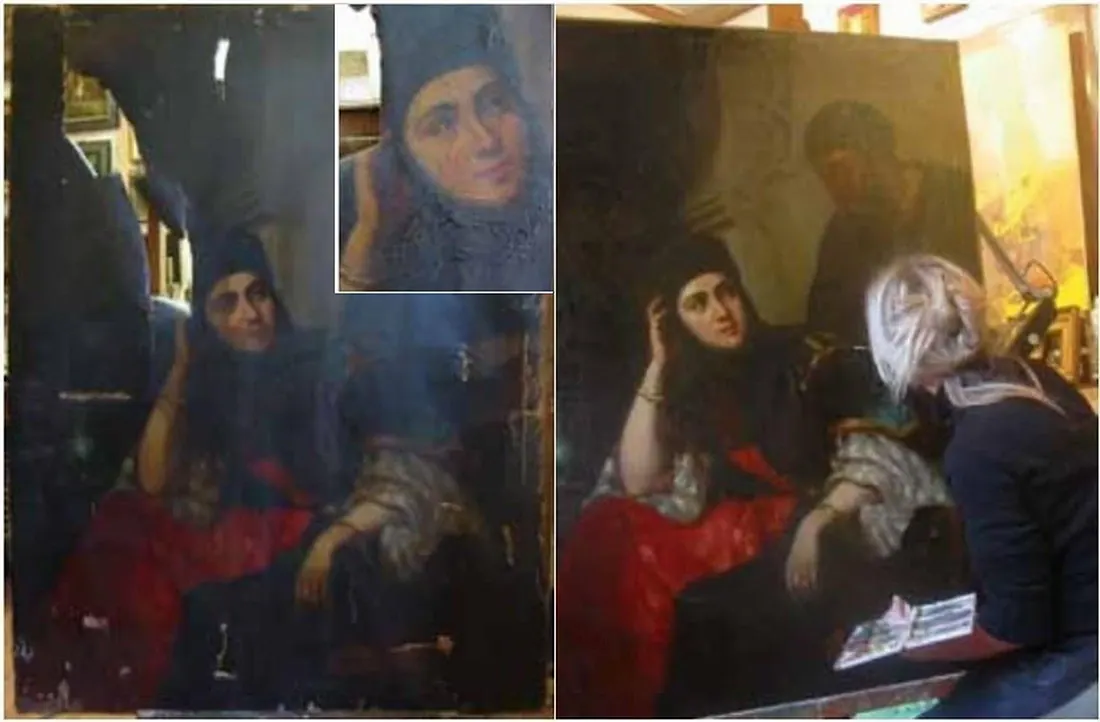
Treatment of fire damage and of a large teara large painting
Fire damage
Before — fire soot and a large tear / Undergoing restoration
Fire soot and a long tear in the canvas: before, and during treatment.
Fire damage
Treatment of fire damage and of a long tear — large-format painting
A large painting, saved from a fire. Soot and blackening had covered the entire surface: the faces, the fabrics, the background — nothing could be read any longer. A long tear crossed the canvas.
The tear is consolidated first and the canvas re-tensioned: no cleaning is undertaken while the support is unstable.
Next comes the reduction of the soot, carried out area by area and in stages. The detail in the roundel shows what the paint layer had kept beneath the deposit: the face recovers its modelling, its flesh tones and its gaze.
The right-hand view was taken during treatment, not at the end of the work.
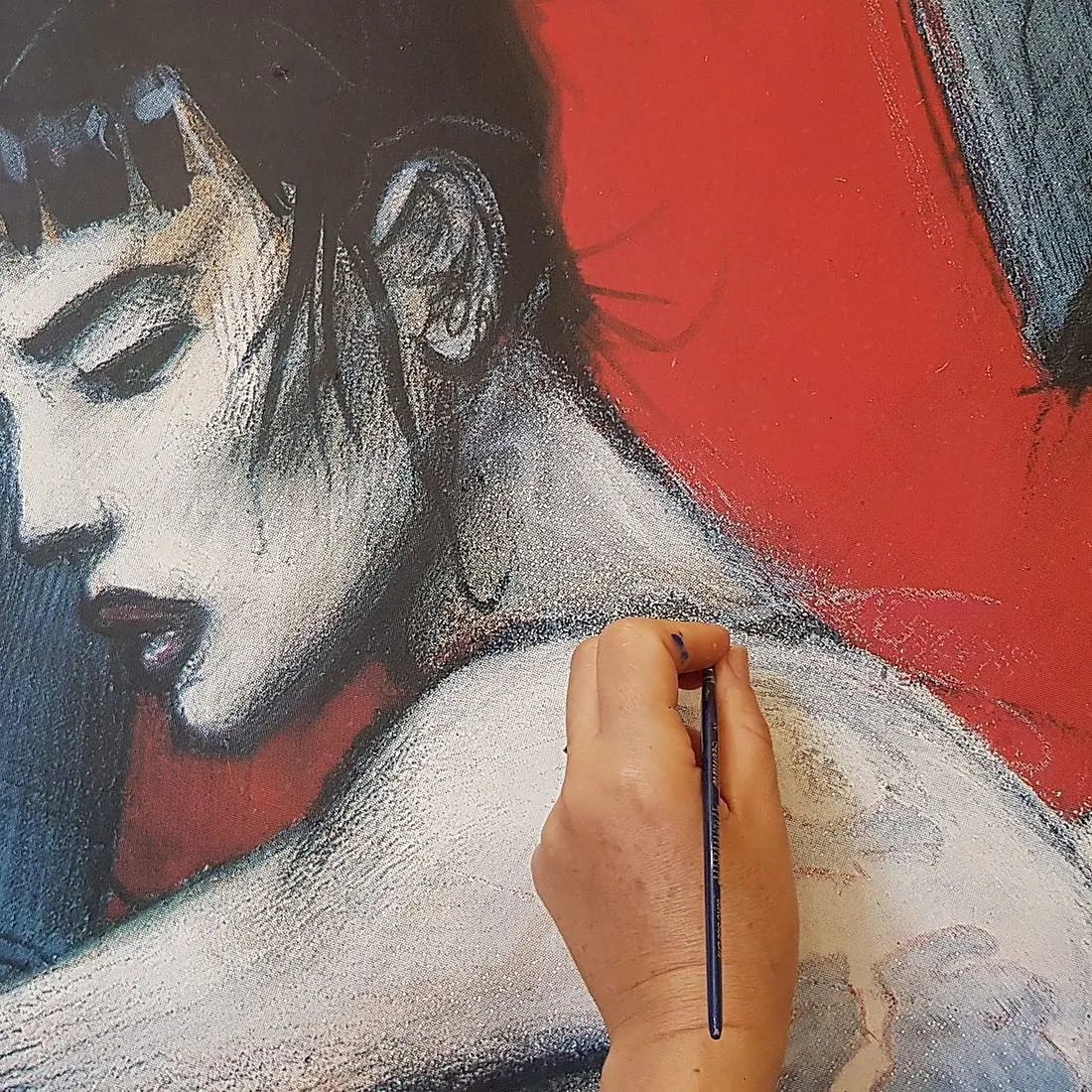
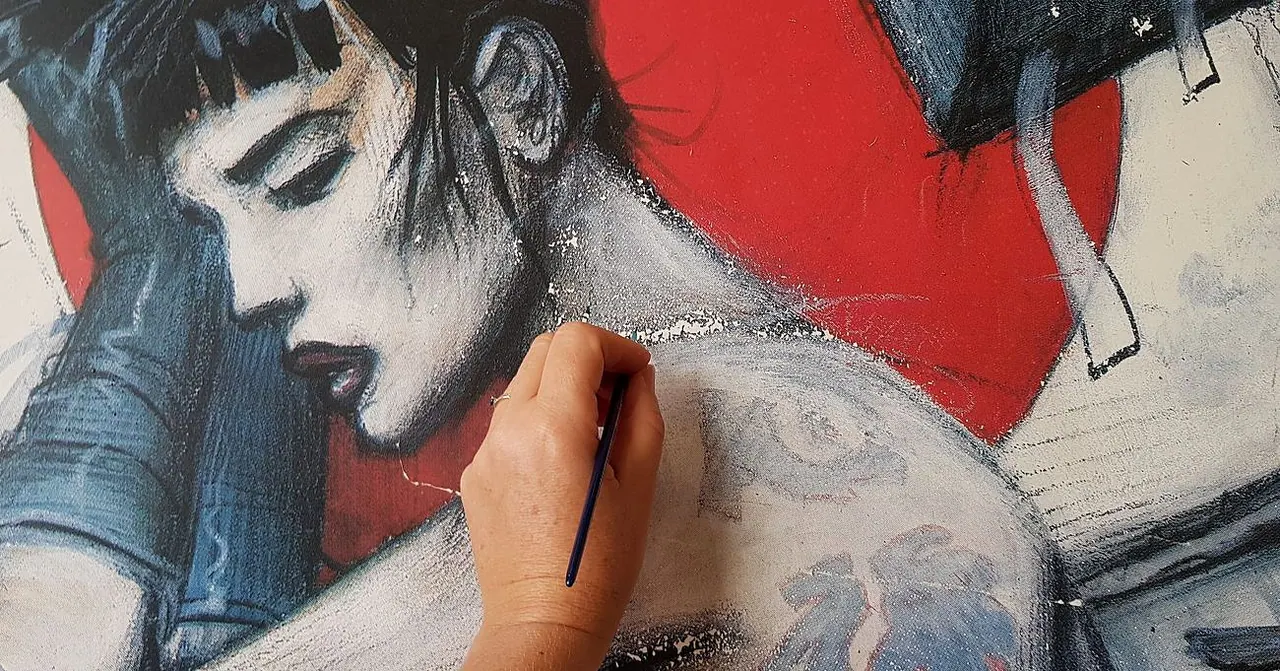
Re-fixing of the flaking paint and reintegration of the colourscontemporary work by Bilal
Flaking paint
Reintegration with a fine brush, in the studio
The flaking of the paint layer, before re-fixing
Consolidation of the flaking paint, then reintegration of colour by illusionistic retouching.
Flaking paint
Consolidation of flaking paint and reintegration of colour — contemporary work by Bilal
Treatment of the flaking paint and reintegration of the colours. On a contemporary work by Bilal, the paint layer had lifted in places: flakes stood proud of the surface, ready to fall. They are consolidated one by one before anything else is done — as long as a flake moves, nothing else can be undertaken.
Then comes the reintegration of the colours, in illusionistic technique: the retouching must disappear to the naked eye and be legible only under the magnifier or in raking light. On this kind of painting the exercise is formidable — broad flat areas, a red with no variation to hide in, and a granular surface whose texture must be matched as closely as its colour.
The materials used are reversible: the treatment can be removed without touching the original.
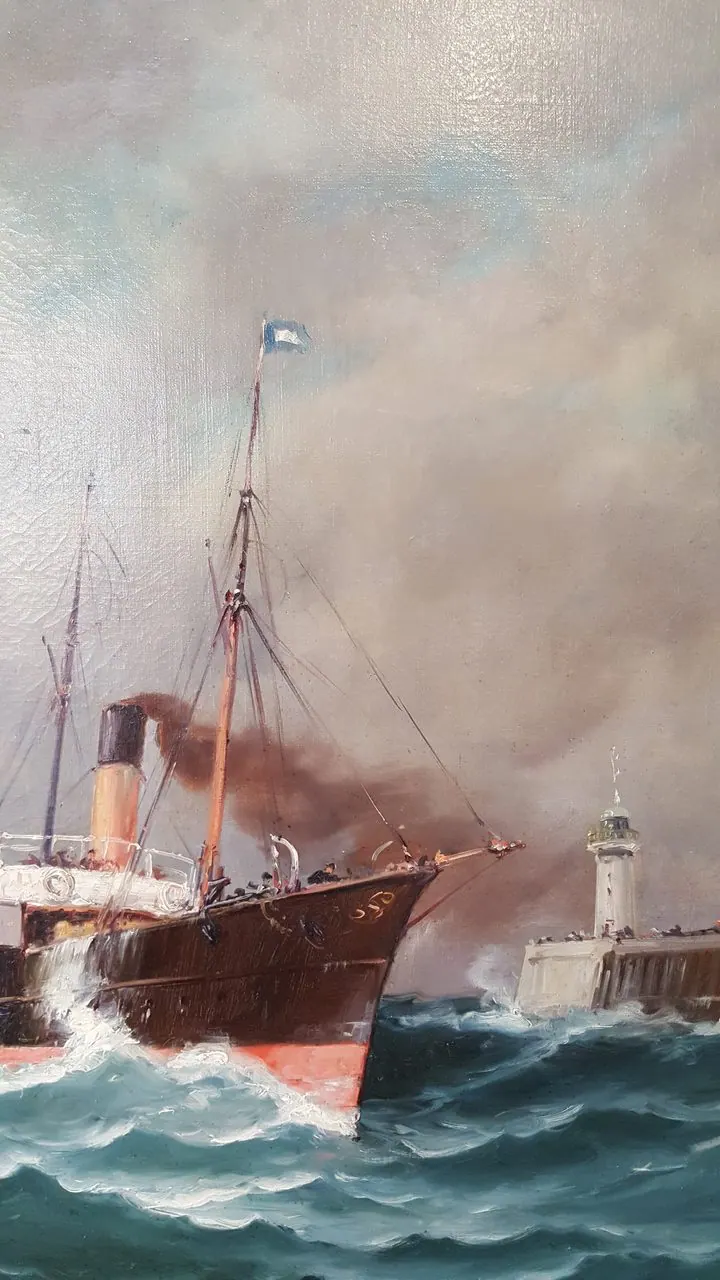
Consolidation of a tear and liningsteamship seascape
Tear
Before / After
Before — general viewAfter — general view
A knock had opened the canvas at an angle in the sky, taking the paint layer away along the edges.
Tear
Consolidation of a tear and lining — steamship seascape
A torn painting calls for knowledge of the quality and the reactivity of the support, as well as the reactivity of all the components, in order to establish the right method of treatment and the appropriate materials.
Restoring a torn painting calls first for protecting the paint layer, so that the weakened areas are preserved while the work is carried out.
Lining a painting remains the last available solution, and only if the canvas has become very fragile over the whole or a large part of the work.
A painting damaged by a tear can be treated by consolidation from the reverse, with a non-woven patch or by the thread-by-thread technique.
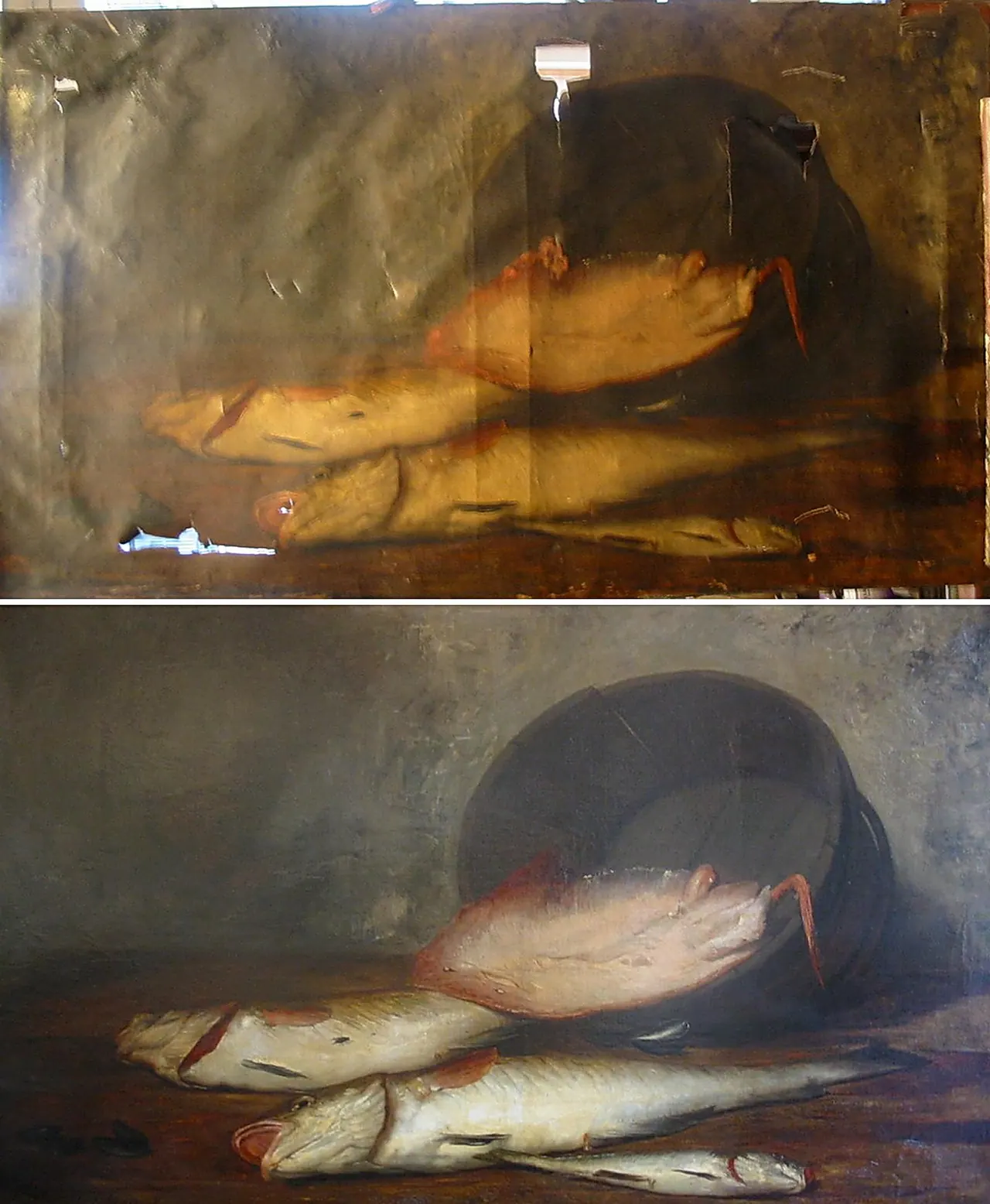
Consolidation, lining and reintegrationstill life with fish
Tear
Above: the paint layer faced for protection, before lining / Below: after lining, reintegration and varnishing
A canvas weakened across its whole surface, protected and then lined.
Tear
Consolidation, lining and reintegration — still life with fish
Consolidation, lining, retouching and varnishing. Lining remains the last available solution, and only if the canvas has become very fragile across the whole or a large part of the painting — as it had here.
The paint layer is protected first: this is the state shown above, the surface entirely covered with a facing paper that holds the material in place throughout the treatment.
The canvas is then consolidated at the back with a new canvas and re-tensioned. The losses are filled and reintegrated, and the varnish comes last — the still life recovers its greys, the red of the crab and the pearl of the fish.
Treatment of distortions: dents and flaring cornersre-tensioning a canvas
Distortions, dents
Before / After — canvas laid flat again and re-tensioned
A poorly tensioned canvas, with dents and corner draws that interfere with the reading of the work.
Distortions, dents
Treatment of deformation: dents and corner draws — re-tensioning a canvas
Treatment of distortions in a painting: dents and flaring corners. A canvas is sometimes poorly tensioned, or shows dents, and this spoils the look of the work.
It is often necessary to flatten the canvas — and therefore to take it off its stretcher, where that is possible — when the deformations are very pronounced.
This stage calls for great vigilance, and for a protective facing to be applied over the whole paint layer before anything is done.
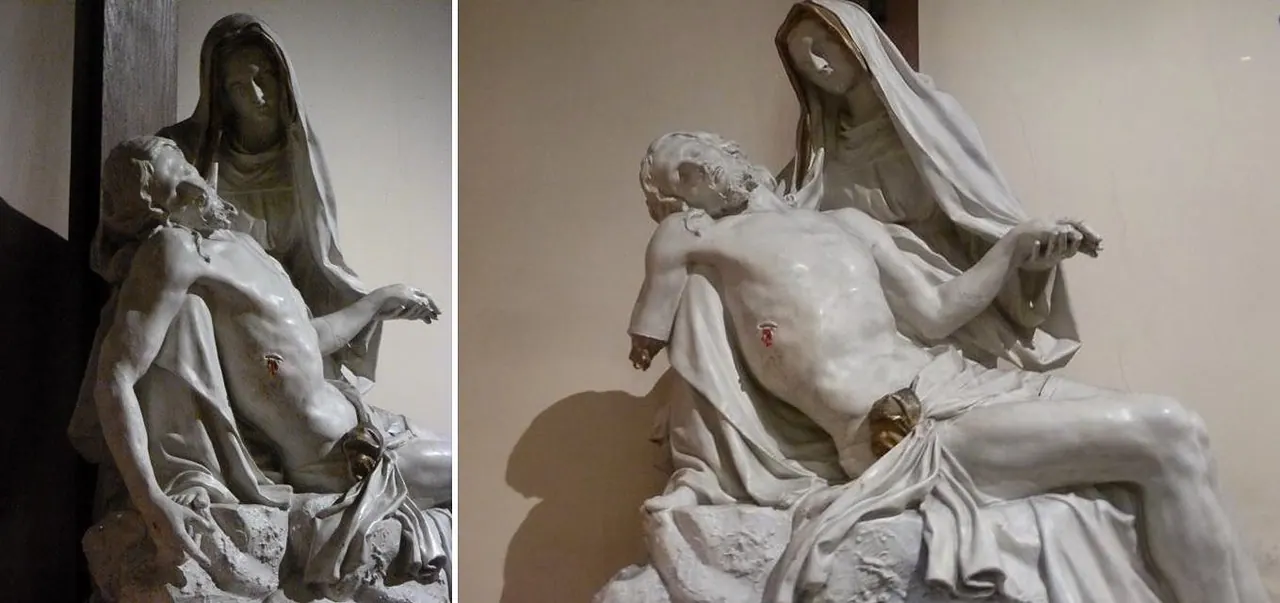
Reintegration of the arm of Christ, broken into twenty-four piecesMichelangelo's Pietà, plaster
Broken elements
Before / After
The fragments, before reassembly
The arm, broken into twenty-four pieces with losses, reassembled and set back on the work.
Broken elements
Reintegration of the arm of Christ, broken into twenty-four pieces — Michelangelo's Pietà, plaster
Reintegration of the arm of Christ on the plaster sculpture of Michelangelo's Pietà (a copy) in the church of Saint-Antoine, Paris 12the.
At the heart of the church of Saint-Antoine stands a copy of Michelangelo's Pietà. The arm of Christ, broken into pieces — twenty-four fragments, with losses — was reassembled and set back into the work.
Restoring the sculpture required the removal of old adhesions and a reworking of the fixing, taking account of the weight of the arm and of the support.
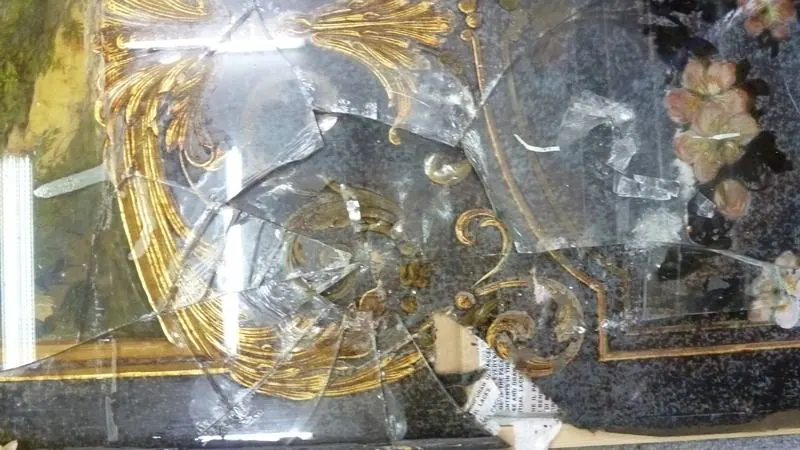
Consolidation of a decoration painted on glass and its remounting on new glassa Paris shopfront
Monumental decoration
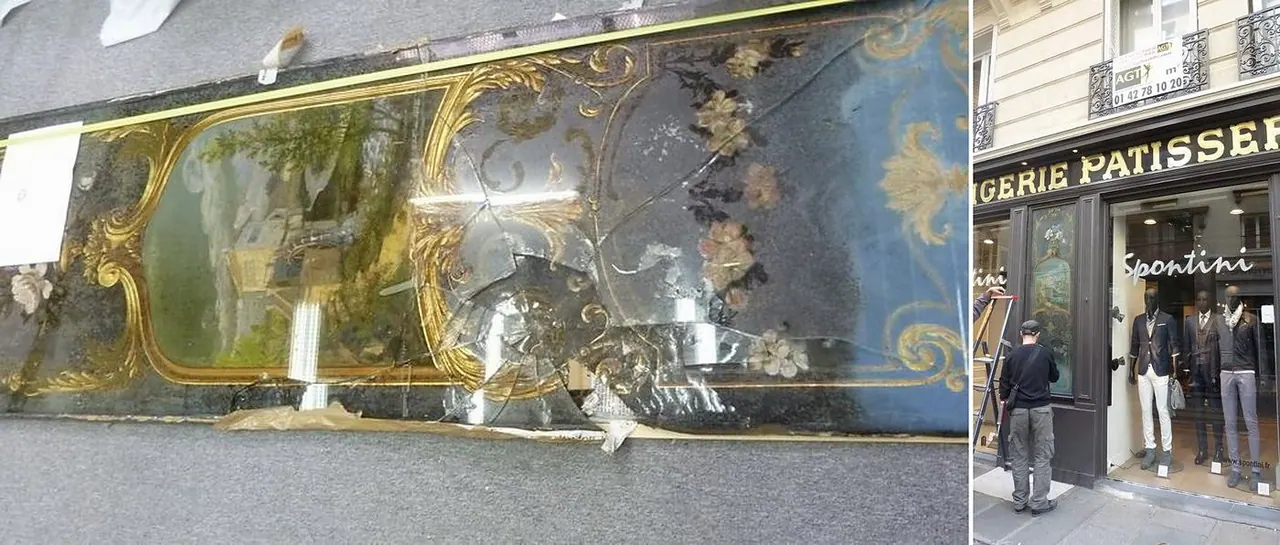
Before — broken panel / After — panel remounted on the shopfront
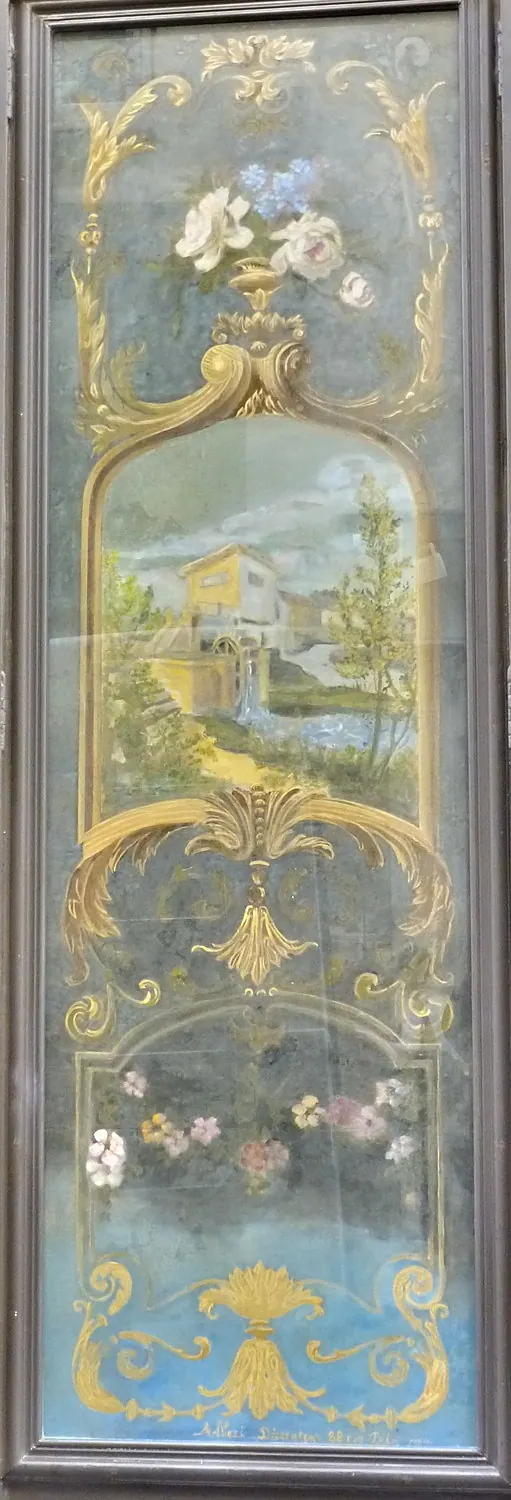
The restored decoration, mounted on new glassDetail of the break
The painted glass panel of a former bakery and patisserie, broken over its whole height.
Monumental decoration
Consolidation of a painted glass panel and its remounting on new glass — a Paris shopfront
A decoration painted on glass, on the scale of a shopfront. The glass panel of a former Paris bakery and patisserie, painted on glass, was broken over its whole height.
This is neither a painting nor a frame: it is a monumental decorative scheme, belonging to the building as much as to the history of the neighbourhood. The support lays down the law — glass cannot be filled or stopped like a canvas, and the painting is read from the other side.
After consolidation and reintegration of the painted decoration, the paint was mounted on new glass, and the panel was then set back in place on the shopfront — gilding, foliage, landscape and garlands of flowers all returned to legibility.
Reassembly of the fragments and reintegrationL’Espiègle, after Jean-Baptiste Carpeaux
Broken elements
Before / After
It arrived in several fragments, the head separated from the base.
Broken elements
Reassembly of fragments and reintegration — The Mischievous Girl, after Jean-Baptiste Carpeaux
L’Espiègle, terracotta bust of Jean-Baptiste Carpeauxwhich reached the studio in several fragments, the head separated from the base.
Reassembly, rejoining, filling of losses and harmonising of tone: the work recovers its legibility as a whole.
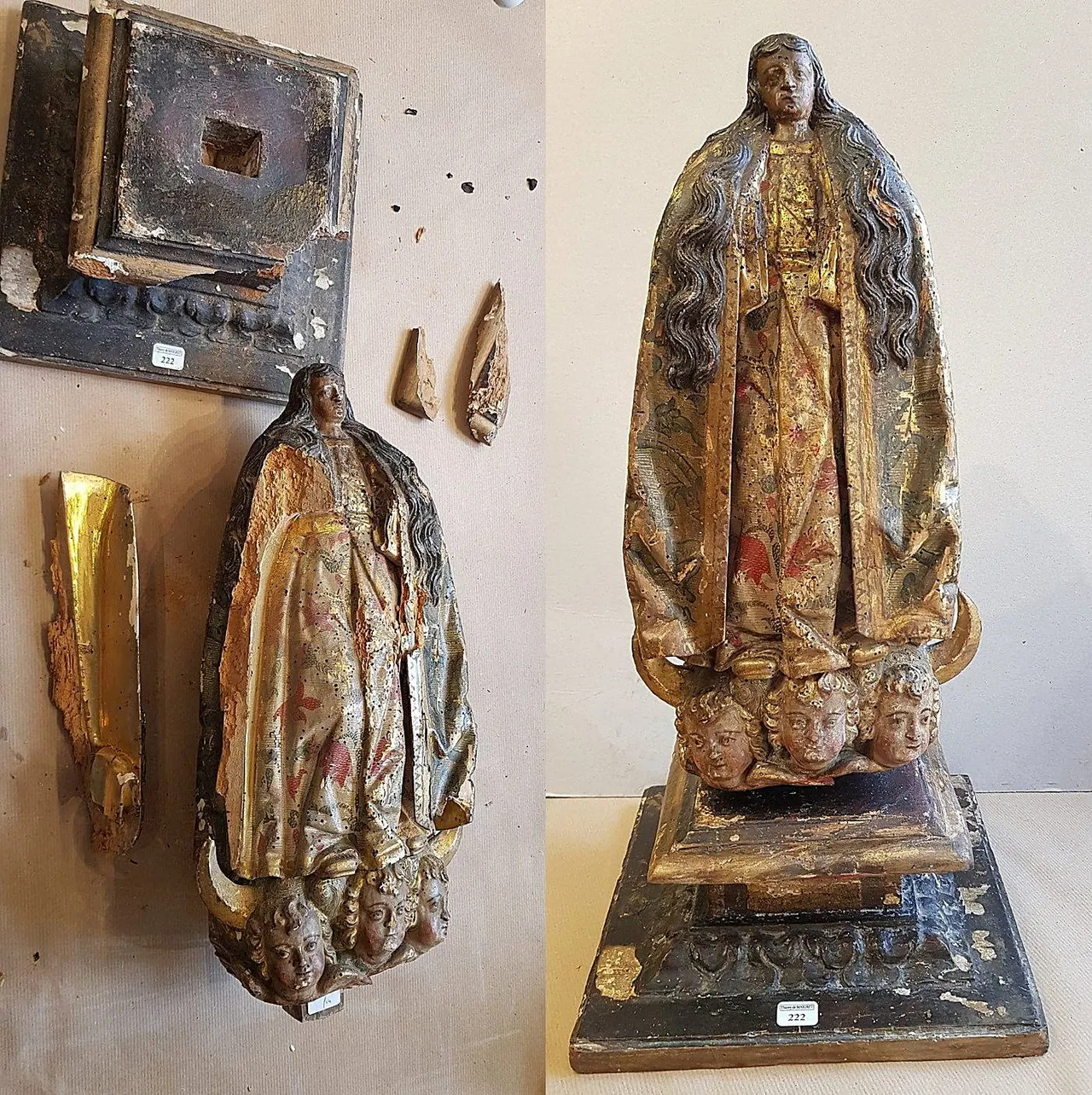
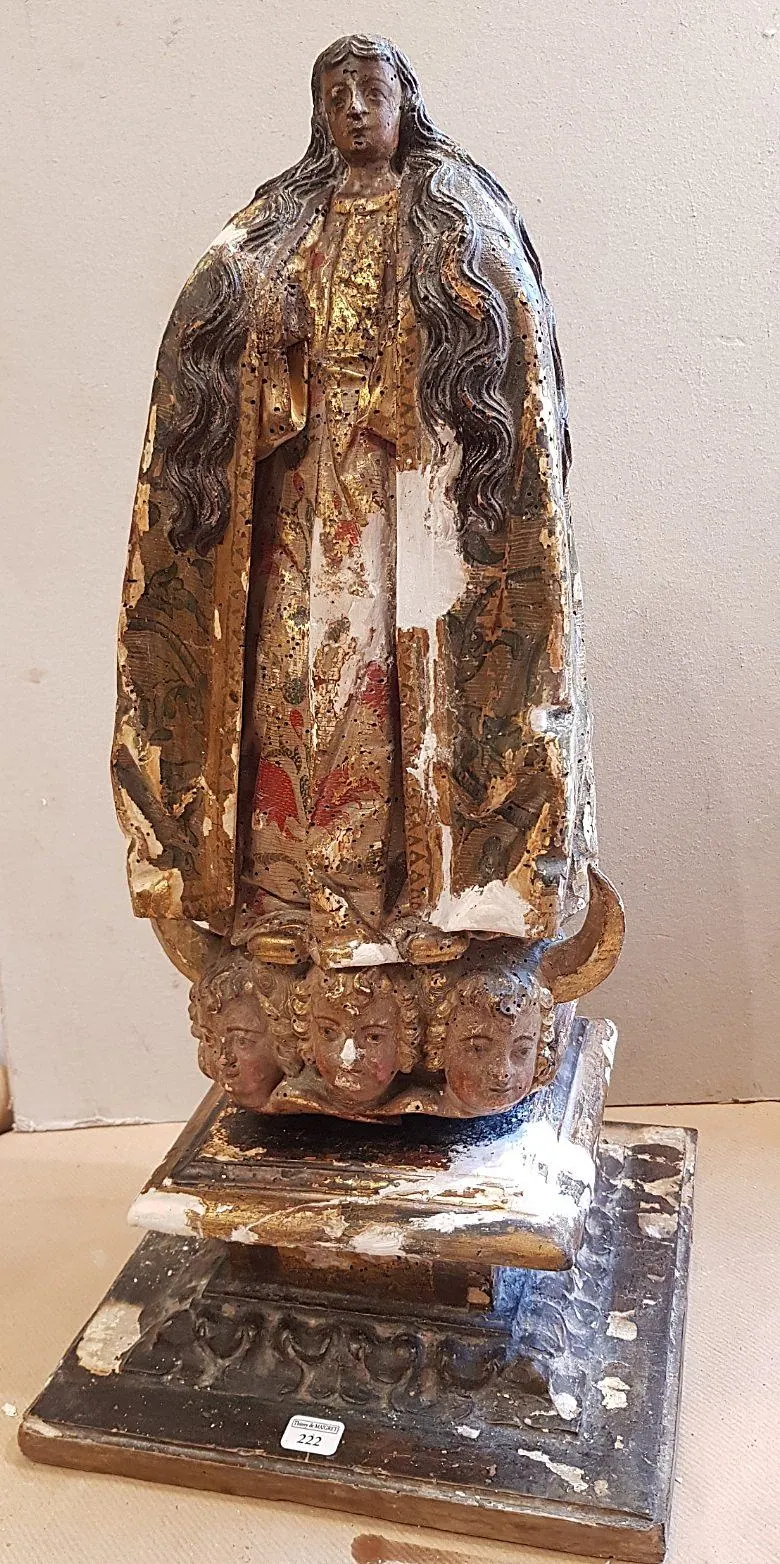
Reassembly, filling and renewal of the gildingVirgin in carved and polychrome wood
Broken elements
On arrival — detached elements · After — reintegration
In progress — filling of the losses
It arrived dismantled: the base separate, the gilded cloud and fragments detached, the wood riddled with flight holes.
Broken elements
Reassembly, filling and reworking of the gilding — Virgin in carved and polychrome wood
The work was broken. It arrived in pieces: the base separated, the gilded cloud detached, and several fragments loose. Everything had to be laid out, the parts assembled, and the missing elements then reintegrated — nothing is remade for as long as the original survives.
The timber was moreover riddled with woodworm tunnels. They were treated, the timber consolidated, and the tunnels made invisible.
The losses are then filled and brought level with the surrounding material — this is the state shown in the third view, deliberately left white.
Reintegration comes last: gilding and polychromy are taken up tone by tone, kept slightly below the original, until the eye travels across the whole figure without catching.
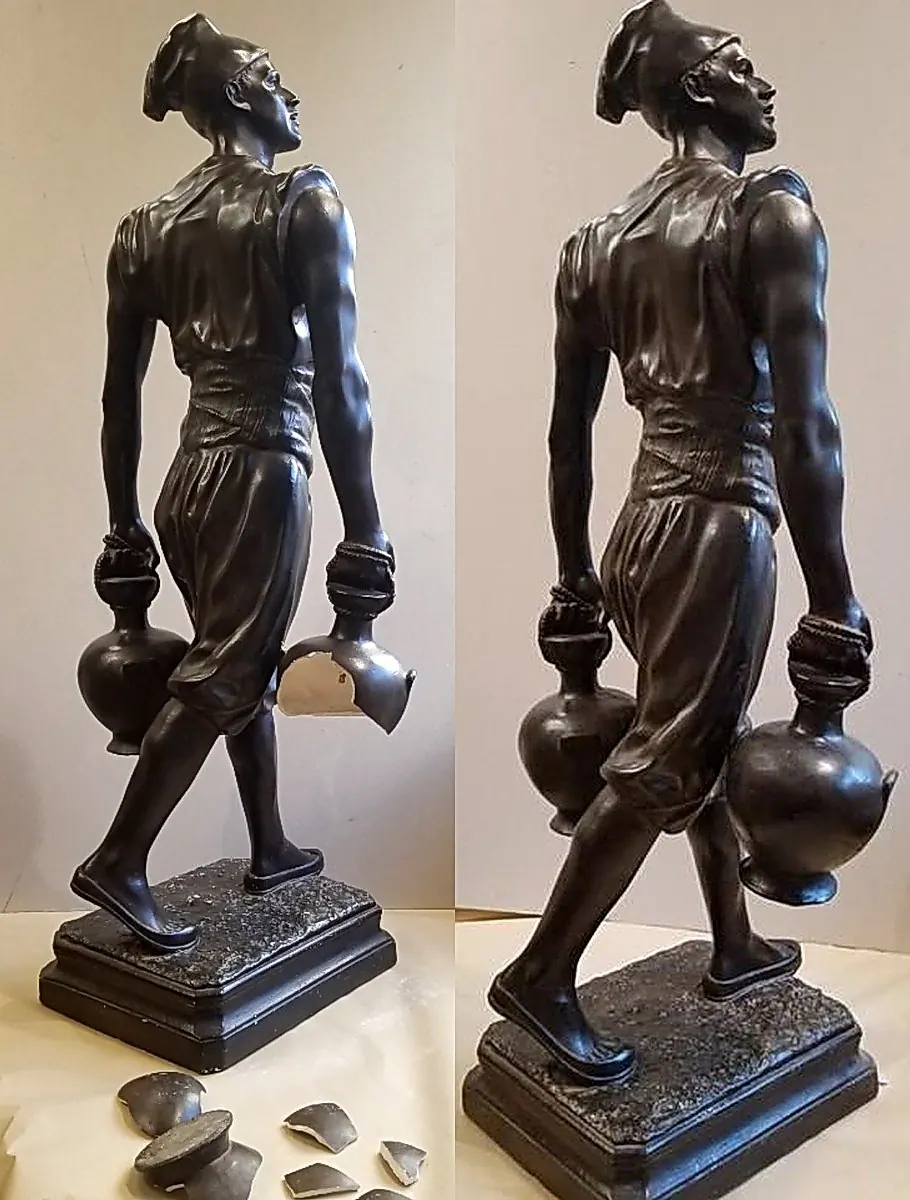
Bonding of the fragments and reintegration of the patinaplaster water carrier
Broken elements
Before / After
The jug broken into several fragments.
Broken elements
Bonding the fragments and reintegrating the patina — plaster water carrier
A water carrier in patinated plaster, its pitcher broken into several fragments: consolidation, assembly of the parts, filling, illusionistic retouching and an isolating layer.
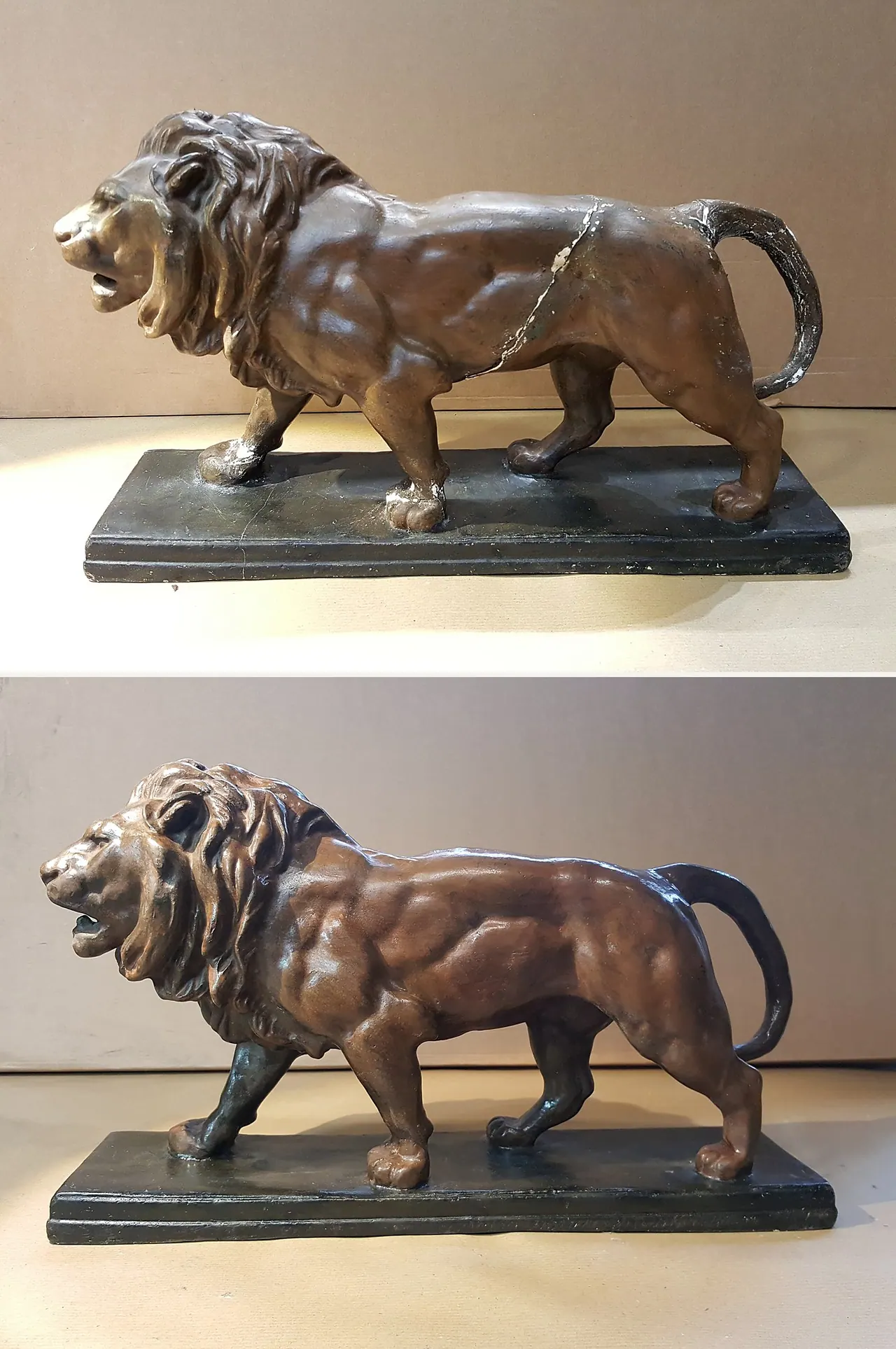
Removal of old bonds and overpaint, then reintegrationlion by Antoine-Louis Barye
Old restorations
Above — before: old adhesions, fills and overpaint / Below — after removal and reintegration
An earlier restoration to be undone before restoration could begin: adhesions, overflowing fills and overpaint.
Old restorations
Removal of old adhesions and overpaint, then reintegration — lion by Antoine-Louis Barye
Lion after Antoine-Louis Barye. The work had been broken in the past and already treated by someone else: the fragments had been stuck back, but the joins were overflowing with filler, and overpaint covered the patina far beyond the losses. The break could be read from one end of the flank to the other.
First it had to be undone. The old adhesions are taken down and the fills and overpaint removed — after testing, with solvents chosen for each material encountered. This is the most delicate stage of the whole treatment: one never knows what an old product has done beneath the surface, and it has to be discovered without taking the original away with it.
The elements are then reassembled along their line of break, the fills remade and brought level, and the colour and patina then reintegrated. The work recovers its original legibility: the modelling of the muscles, the movement of the mane, and the contrast between the bronze of the coat and the dark green of the base.
Working after an earlier restoration is often more difficult than working on an untouched piece. This is where the demands of the craft lie: knowing the materials, their reactivity and their compatibility, and using only products that are appropriate, stable, identifiable — and reversible, so that whoever works on the piece after us can undo what we have done.
The stages of the treatment
01Condition report: identifying old bonds, fills and overpaint
02Reactivity tests on every material encountered
03Removal of the old bonds, of the fills and of the overpaint
04Reassembly along the line of the break, fills remade and levelled
05Reintegration of the colours and the patina, with reversible materials
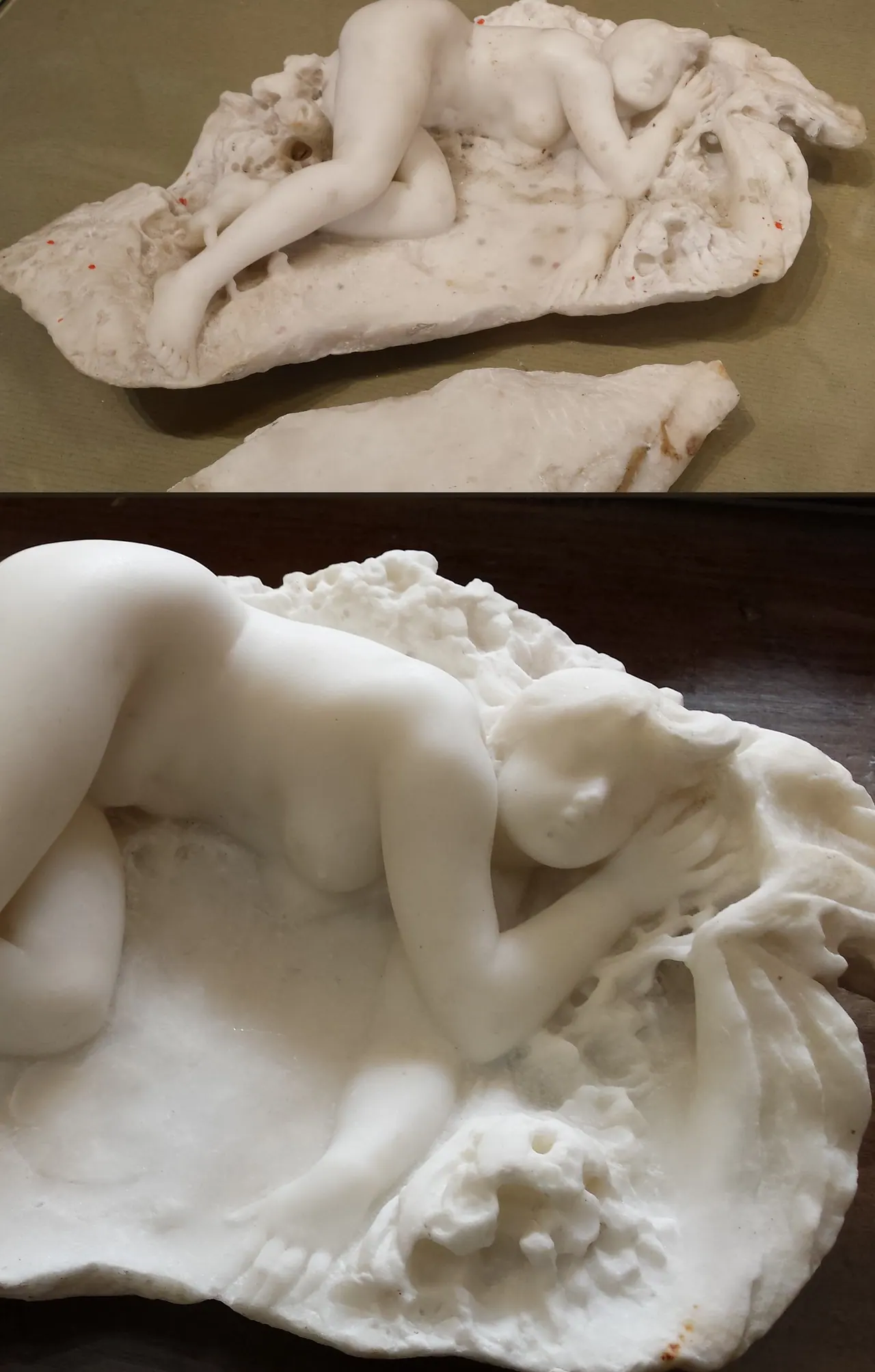
Bonding of the fragment and cleaning of the marblesculpture by Edme Marie Cadoux
Broken elements
Above — before: the detached fragment, the soiled surface / Below — after: the marble secured, losses made good and illusionistic retouching
Broken during a removal, and darkened by numerous stains and soiling.
Broken elements
Bonding the fragment and cleaning the marble — sculpture by Edme Marie Cadoux
Marble sculpture by Edme Marie Cadoux, damaged during a house move. A chip of the drapery had broken away, and the surface, darkened by numerous stains and soiling, had lost the whiteness of the stone — down to spatters of paint.
The fragment is bonded back along the line of the break, with a reversible adhesive, after a dry fitting: the two faces of a break fit together in one way only, and it is that position which must be found before anything sets. The join is then filled and retouched to the tone of the stone.
Marble is a porous stone: a stain does not stay on the surface, it migrates into the mass of the stone. It is therefore not scrubbed away but drawn out. After testing, cleaning is carried out with poultices, which slowly absorb what has penetrated, area by area — with no running water, and no acidic product, which would eat into the polish and leave a matt halo.
With the soiling gone, the stone recovers its grain and its light: the deep whites of the body, the veil of the drapery, and the translucency the sculptor had gone looking for in the thickness of the block.
The stages of the treatment
01Condition report, identifying the stains and the old fills
02Dry fitting of the fragment, then bonding along the line of the break
03Filling and retouching of the join, to the tone of the stone
04Tests, then cleaning of the marble with compresses, area by area
05Checking under raking light: no residue, no tideline
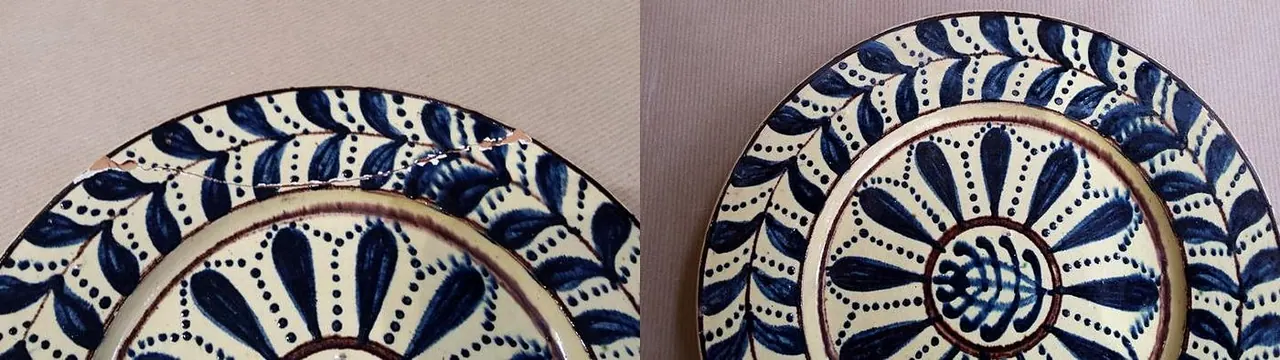
Bonding and reintegration of a fractured faienceplate
Broken elements
Before / After
The break ran across the rim, with losses in the enamel.
Broken elements
Bonding and reintegration of a fractured faience — plate
Faience plate fractured across the rim, with losses of glaze. Rejoining the fragments, filling and retouching give the decoration back its continuity: the break disappears from the reading.
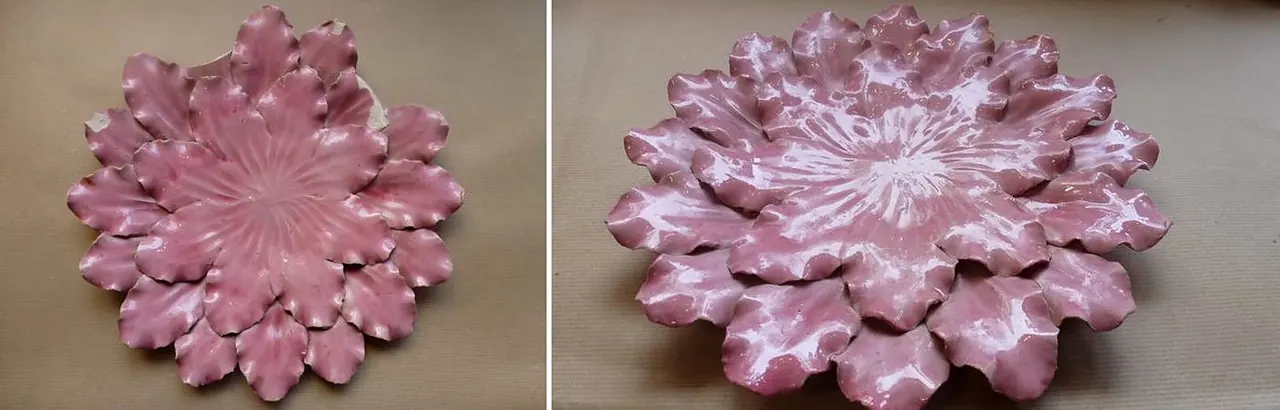
Bonding and filling of the lossesa glazed ceramic bowl, in the form of a flower
Broken elements
Before / After
Many broken petals, losses and a dulled enamel.
Broken elements
Rejoining and filling of losses — flower-shaped glazed ceramic dish
A flower-shaped dish, which arrived with many petals broken, losses and a dulled glaze: the fragments were rejoined, the missing parts made good, and the retouching and glaze then taken up again.
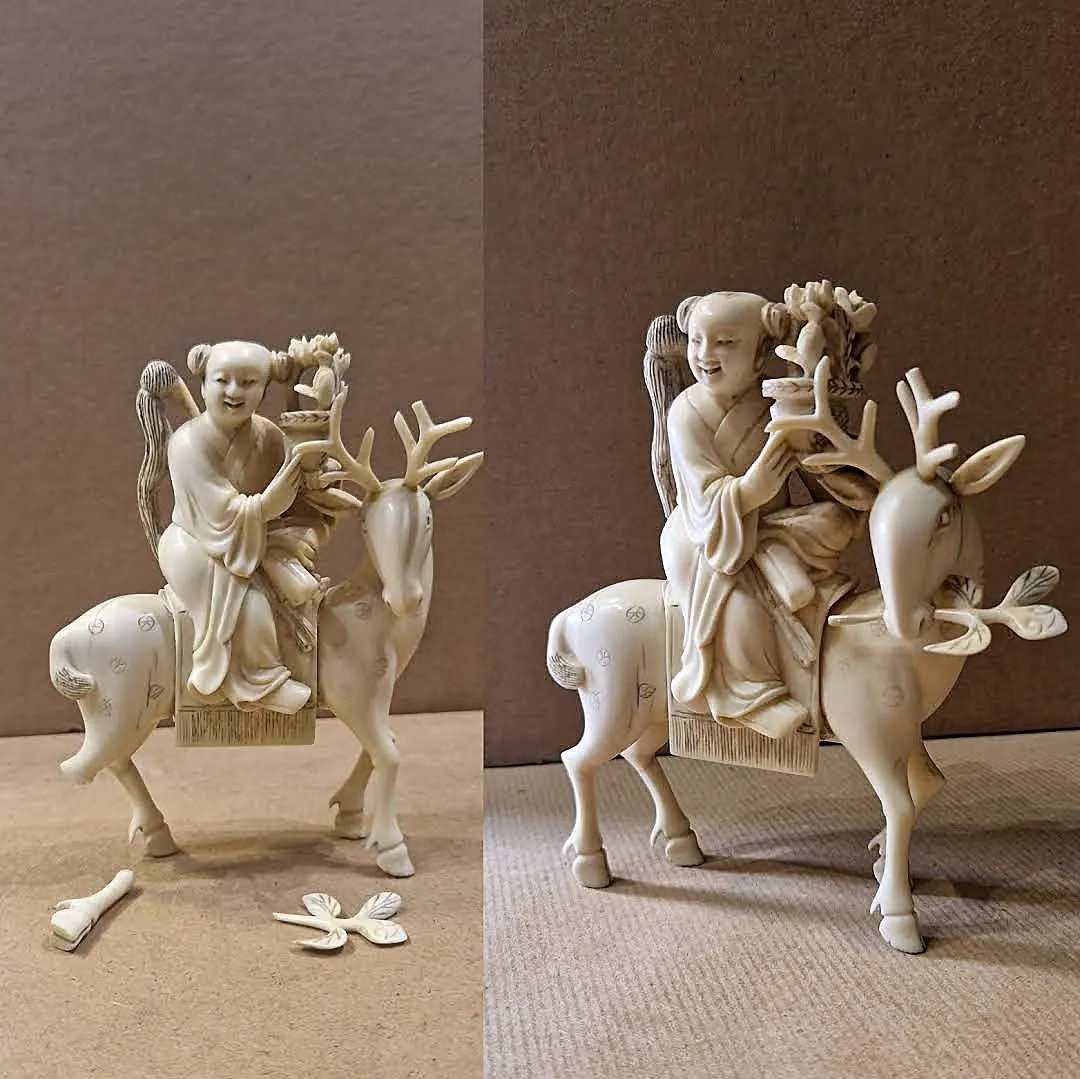
Securing the broken elements and making good the lossesivory group, a rider upon a stag
Broken elements
Before / After
One of the animal's legs, and the leafy branch it carries in its mouth, had broken away.
Broken elements
Securing of broken elements and reintegration of material — ivory group, rider on a stag
Carved ivory group. The work arrived with one of the animal's legs broken and the leafy branch it holds in its mouth detached, laid beside it in several pieces.
Each fragment is repositioned and secured along its original break: nothing is remade for as long as the original survives.
The losses are filled and toned to match the colour of the old ivory.
Bonding and filling of the lossesivory powder-box lid
Broken elements
Before / After
Broken into two pieces and missing its handle.
Broken elements
Bonding and filling of the losses — ivory powder-box lid
The lid of an ivory powder box, broken in two and missing its knop. Once the fragments were secured, the missing material was made good, toned and varnished until the break disappeared from view.
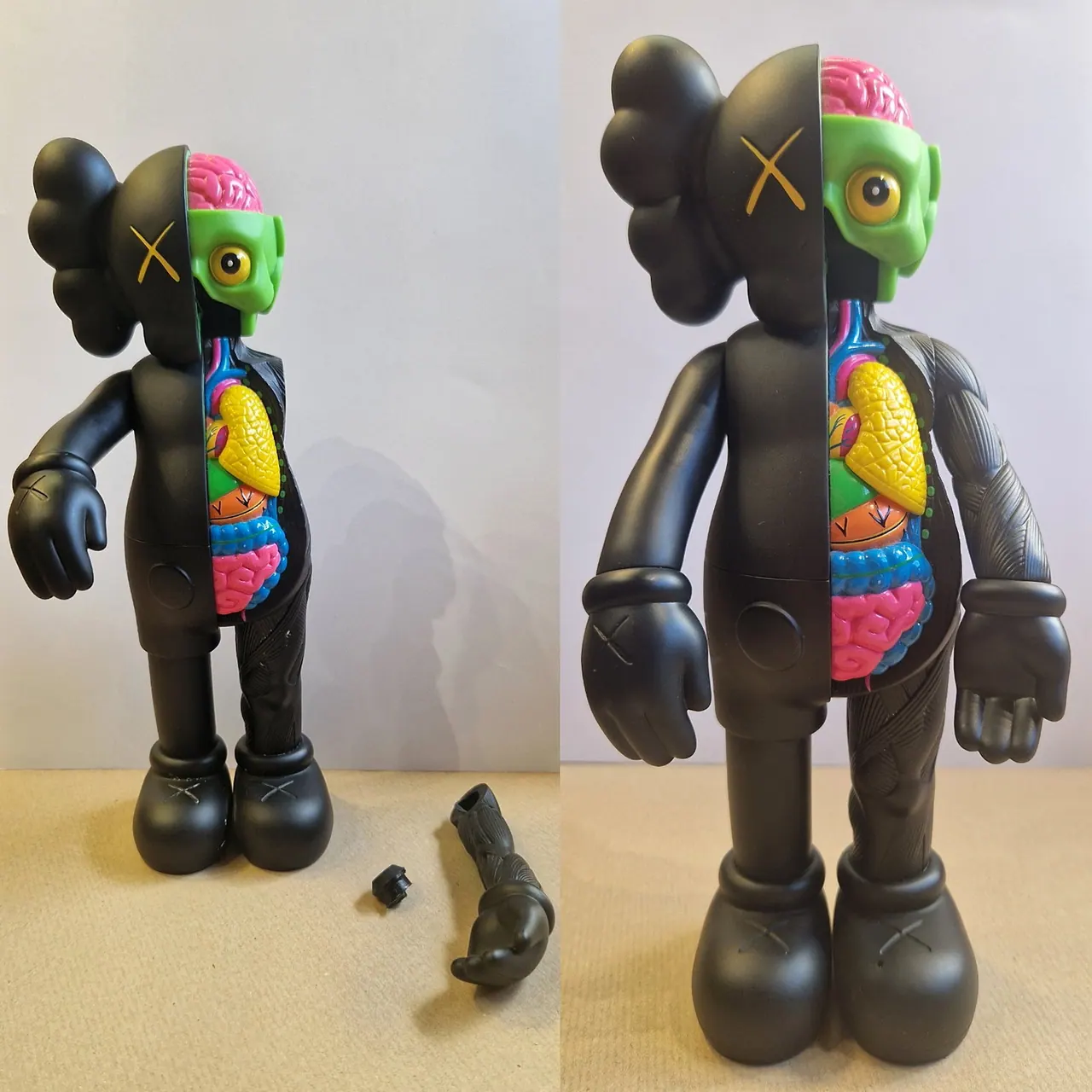
Refitting an articulated armvinyl figure by KAWS
Broken elements
Before / After
It was not enough to bond it: the arm had to regain its movement.
Broken elements
Refitting an articulated arm — vinyl figure by KAWS
Vinyl figure by KAWS, whose real name is Brian Donnelly, an American artist born in 1974 in Jersey City. Coming from graffiti and skateboarding, he worked as an animator on animated series produced for Disney — One Hundred and One Dalmatians, Daria, Doug — and stands for a popular art, within everyone's reach.
His figure Companion, opened to reveal its organs, is a nod to Mickey Mouse as much as to the artists who opened bodies in order to study them, from antiquity to Leonardo. Still at work today, he continues to produce these editions, which are much sought after.
Dimensions: 26 cm high × 12.7 cm wide × 7.6 cm deep.
This Companion set me thinking about restoration non-invasive and lasting. The broken arm was articulated: rejoining it was not enough, its movement had to be given back. Quite a story. After several days of research and trials, I found the way.
The solution always comes when you take the object's side: the work must not show, and it must give the piece back all its original qualities.
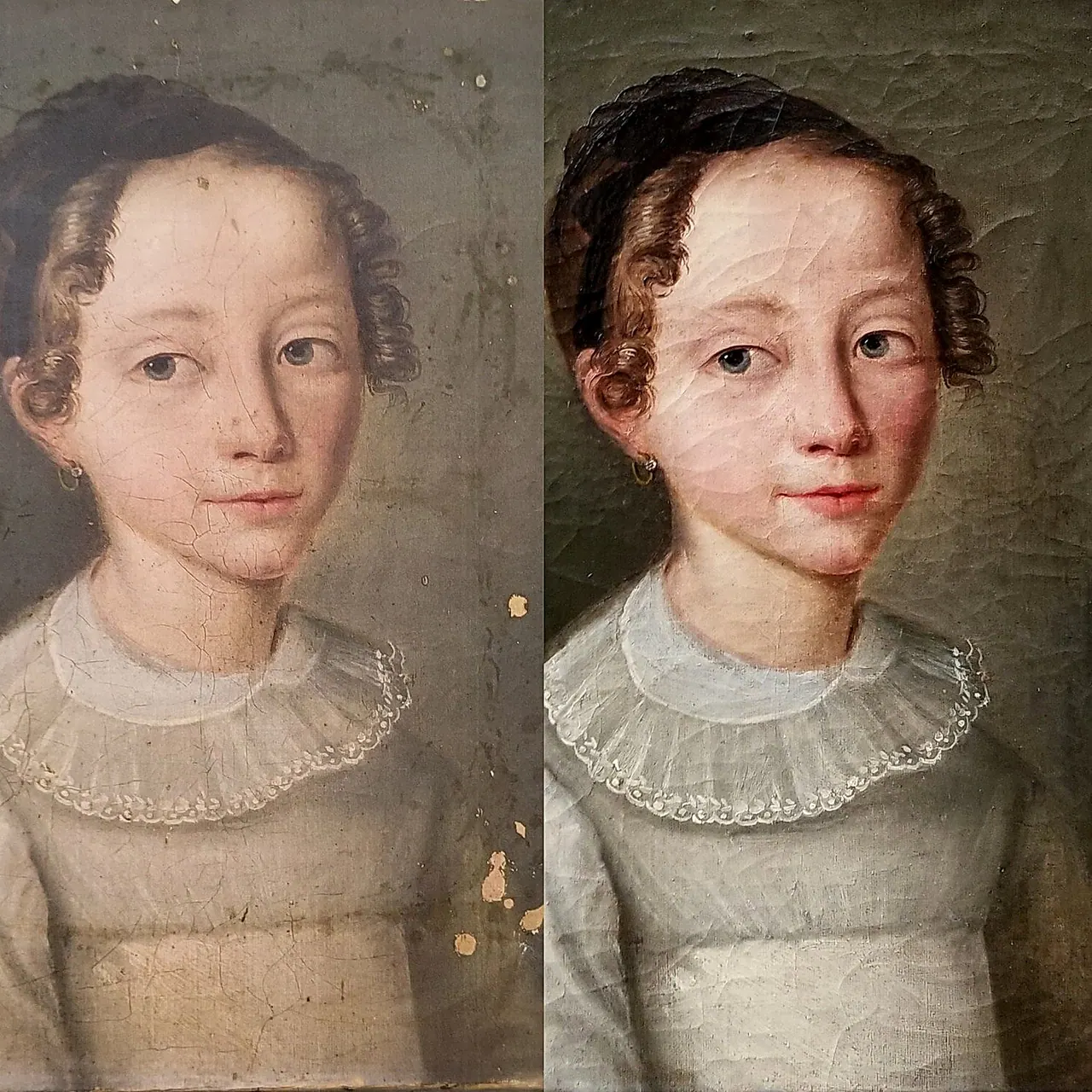
Removal of the old restorations and reintegration of the coloursportrait of a young girl, 18th century
Losses & wear
Before / After — removal of the old restorations and reintegration
Retouching, resins and fillers laid on in the past read more strongly than the work itself.
Losses & wear
Removal of earlier restorations and reintegration of colour — portrait of a young girl, eighteenth century
Portrait on canvas of the 18th century, showing losses and the traces of an earlier restoration. Retouching, resins and fillers had been laid over the paint layer; with time they had discoloured and read more strongly than the work itself.
Removing these earlier restorations comes first. It calls for distinguishing, under the magnifier, what belongs to the original from what has been added to it: only the addition is taken away, never the painter's own material.
The losses are then filled level with the surrounding surface and the colours reintegrated — the flesh tones, the hair, the ruff and the background recover their continuity, with nothing repainted beyond the loss itself.
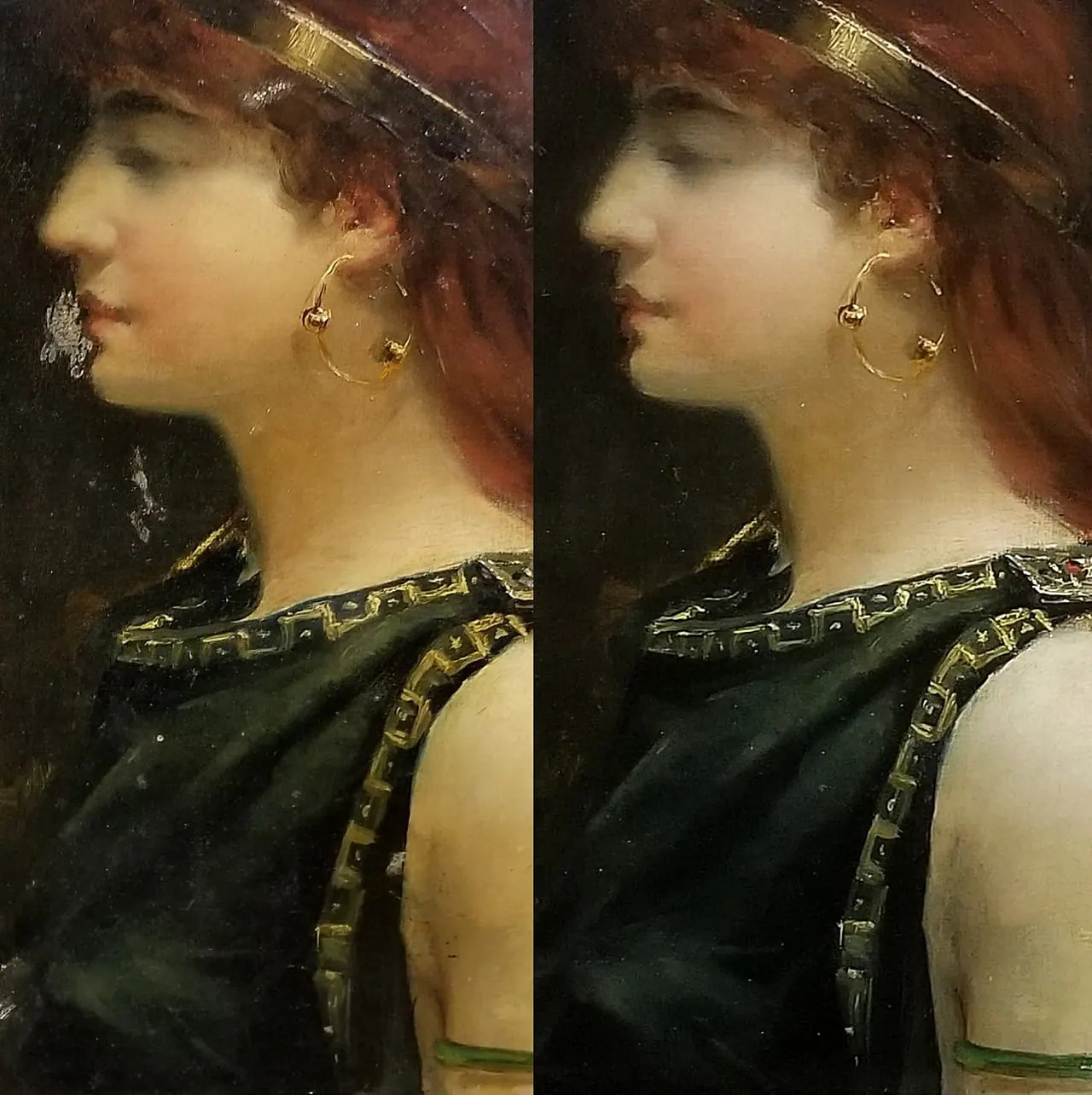
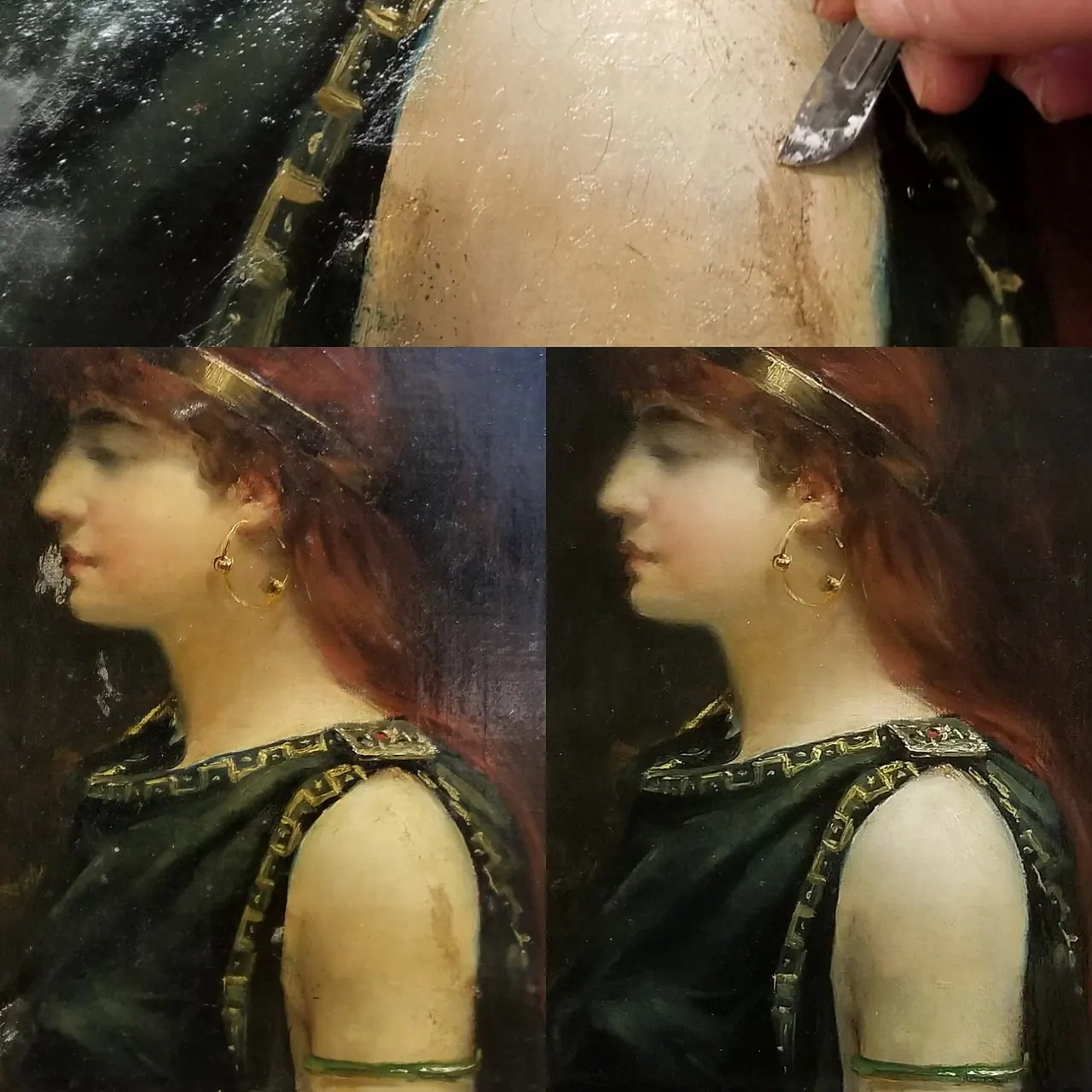
Filling of the losses and illusionistic retouchingprofile portrait with a large ring
Losses & wear
Before / After — the losses made good
Removal with the scalpel, then before / after retouching
Losses left the white ground showing on the cheek, the neck and the background.
Losses & wear
Filling of losses and illusionistic retouching — portrait in profile with a large hoop earring
Filling of the losses and renewal of the varnish. Losses in the paint layer left the white ground showing on the cheek, the neck and the background.
Each loss is filled level with the surrounding paint, then reintegrated in watercolour with a fine brush, tone by tone and slightly below the original: the retouching is legible under the magnifier, never to the naked eye. The varnish is then regenerated to give the modelling back its depth.
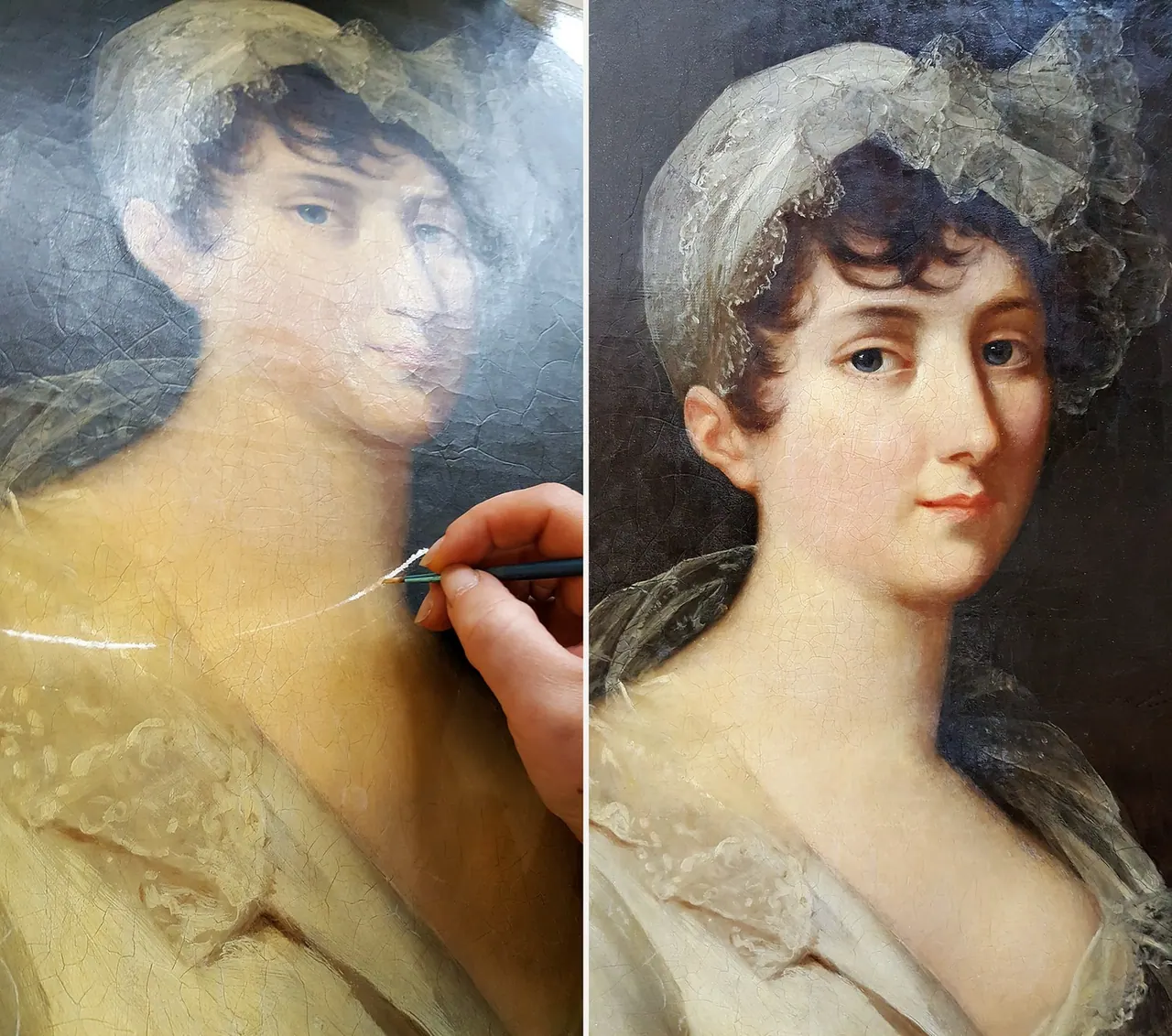
Treatment of a scratch that had carried away the paint layer and the groundportrait, early 19th century
Scratch
Under treatment — the scratch showing light / After — the line has gone
The neck after treatment: the scratch can no longer be read
The pale line across the neck is not a scratch in the varnish: it is the ground laid bare.
Scratch
Treatment of a scratch that had taken away the paint layer and the ground — portrait of the early nineteenth century
A scratch across the neck and the shoulder. It had not merely scratched the varnish: it had taken away the paint layer and even the white ground. It was this ground, laid bare, that read as a pale line from one side of the neckline to the other — the eye caught on it before it even saw the face.
The treatment follows the order of the layers: consolidation of the edges of the loss, then a fill brought exactly level with the surrounding surface — neither hollow nor proud, for a badly judged thickness betrays itself in raking light long before the colour is noticed. Retouching comes only afterwards.
It is carried out with a fine brush, in delicate hatching, within the loss alone. The difficulty is not the colour: it is the network of age cracks running across the whole of the flesh. A smooth retouch, however perfectly matched, would read as a new mark in the middle of an old skin; the pattern of the craquelure must therefore be carried across the fill so that the eye reads the surface as continuous again.
The materials used are reversible and the retouching stops at the edge of the loss: to the naked eye the scratch has gone; under raking light and ultraviolet it remains identifiable. That is as it should be — a restoration is meant to be legible, not hidden from anyone who knows how to look.
The stages of the treatment
01Condition report and examination of the scratch under raking light
02Consolidation of the edges of the loss
03Filling, levelled exactly with the surrounding surface
04Retouching with a fine brush, in hatching, within the loss alone
05Carrying the pattern of the craquelure across the fill
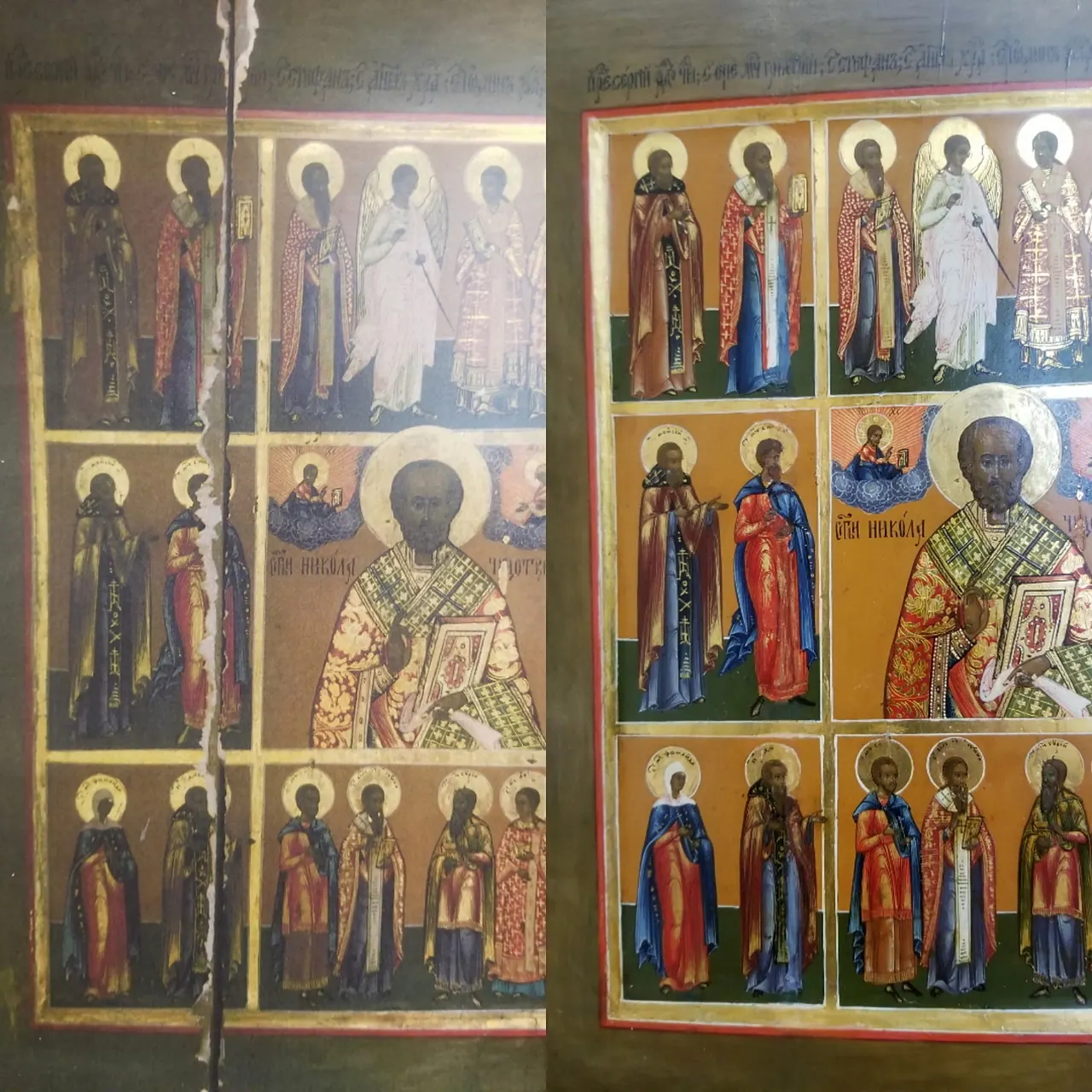
Consolidation of a split panel and reintegration with the needleicon, calendar of saints
Split in the support
Before / After
A long split ran the whole length of the panel: consolidation, and then the reintegration of colour.
Split in the support
Consolidation of a split panel and reintegration with the needle — icon, calendar of saints
A split icon depicting a calendar of saints. The panel was crossed by a long split running its whole length. It first had to be consolidated on either side: as long as the support is unstable, no work on the paint has any meaning.
The work is painted in tempera, with pigments bound in egg yolk and sometimes egg white. The technique grows fragile with age, and parts of the paint layer had been lost. Consolidation is carried out with reversible adhesives and products, the losses are then filled, and the colours reintegrated across the whole of the work.
The retouching calls for extremely fine brushes, and sometimes for a needle. That is the price at which the figures, the finely worked heads and the precision of the faces recover their legibility, exactly as before.
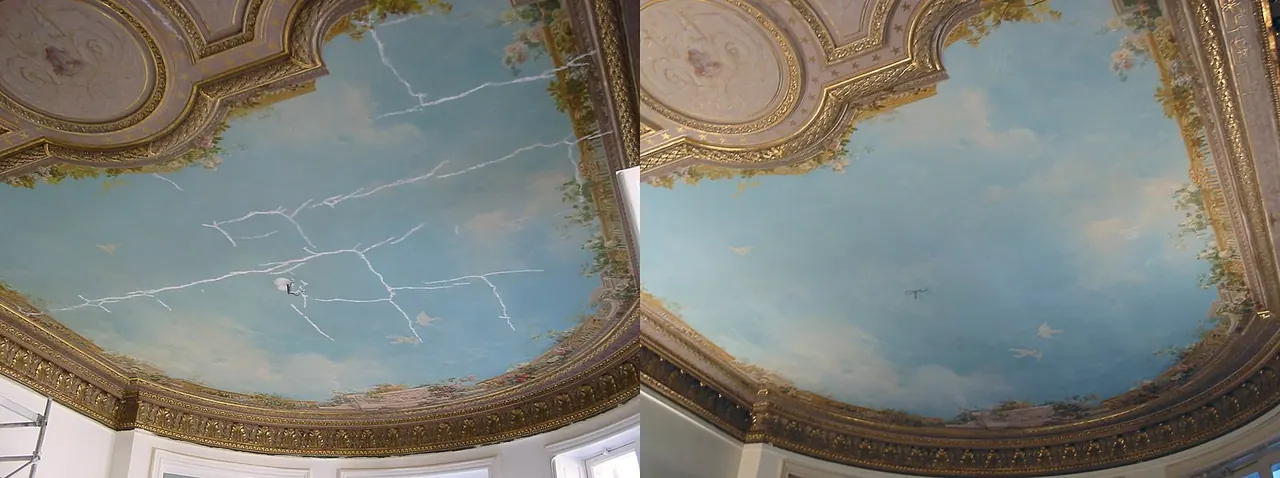
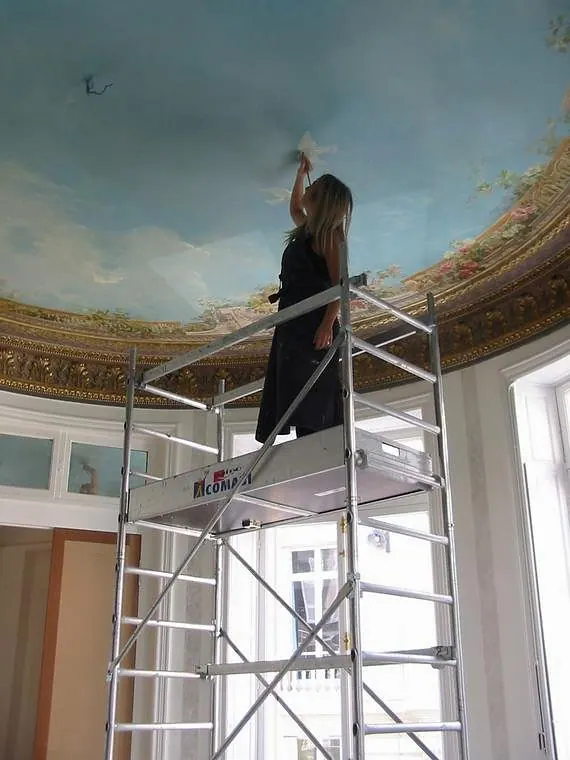
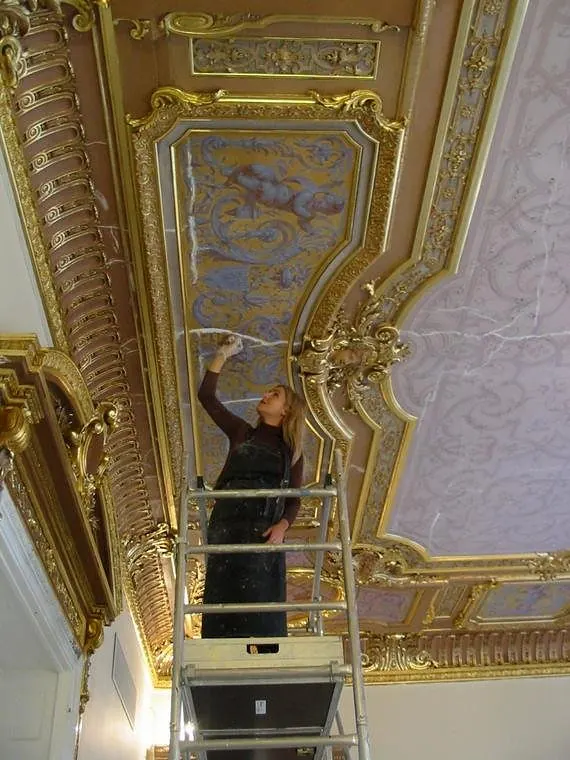
Consolidation of the cracks and reintegration of the colourspainted ceiling
Cracks
Before: the cracks consolidated / After: colour reintegrated, once the cracks had been consolidated
Painted ceiling — work in situReworking of a painted cofferRetouching of a medallion, coffered ceiling and gilding
Cracks in the support ran right across the sky; they were consolidated, then reintegrated.
Cracks
Consolidation of the cracks and reintegration of the colours — painted ceiling
Consolidation of the cracks and reintegration of the colours. The support of the ceiling had moved: a network of cracks ran right across the sky, and into the foliage and the ornament around it.
The cracks are first consolidated and filled — this is the state shown on the left, the fills deliberately left white and visible. The colour is then reintegrated crack by crack, from the scaffolding, following the modelling of the sky and the passage of the clouds.
A work of this scale does not leave its setting: the studio travels to it. Every retouch must read correctly six metres below and at thirty centimetres alike.
The two photographs were taken under different lighting; their balance has been harmonised so that only the difference of condition can be read.
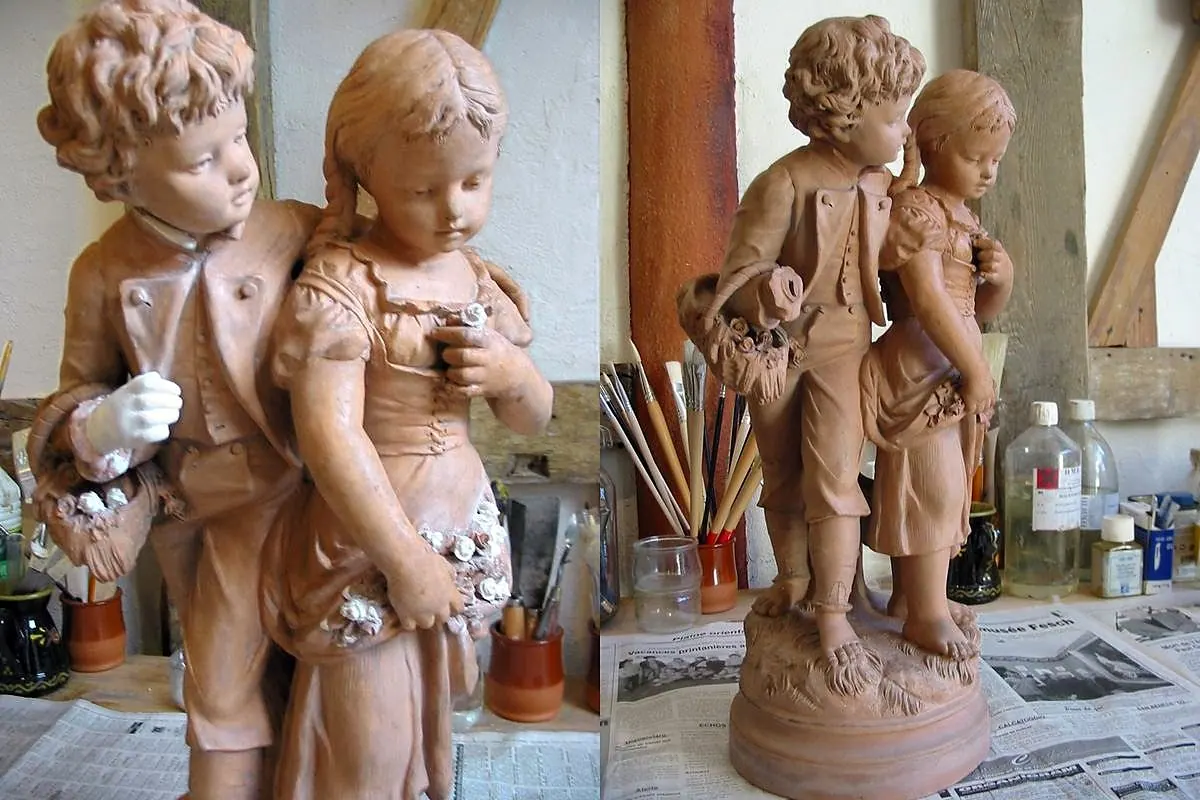
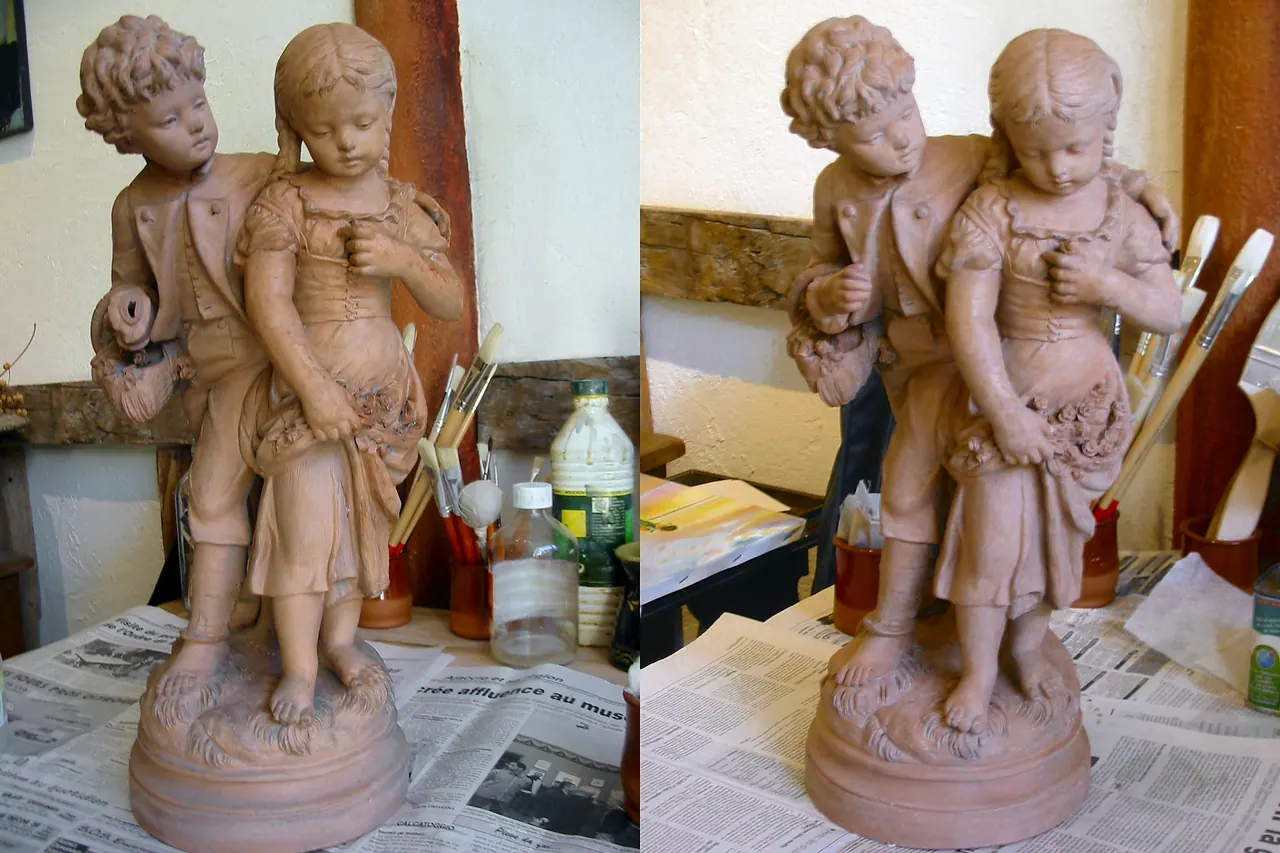
Restitution of the missing parts and reintegration of the coloursterracotta sculpture
Missing parts
Restored parts, before retouching · After harmonisation
Before: the missing hand and numerous losses / After: the hand restored and the colours reintegrated
Hand recreated from nothing, losses filled, then the colours reintegrated.
Missing parts
Restitution of missing parts and reintegration of colour — terracotta sculpture
The missing parts are made good in a material compatible with terracotta, then brought level with the surrounding surface. The photograph on the left shows the intermediate state, deliberately left visible.
The child's hand had disappeared entirely. It was recreated from nothing — modelled, fitted to the position of the arm and to the gesture holding the bouquet — and the many losses in the garment and the base were filled.
The reintegration of colour comes last: it does not seek to imitate. It keeps the new work slightly below the original, so that the eye travels without interruption while the intervention can still be told apart at close range.
The four photographs were taken at different moments of the treatment and under different lighting; their balance has been harmonised to the same terracotta orange, so that only the difference of condition can be read.
Taking impressions of the mouldings and restoring the missing ornamentantique frame
Missing parts
Reworking the ornament with tools, in the studio
Acanthus leaves, shells, bead-and-reel, ovolos: taken by impression, then recreated.
Missing parts
Taking impressions of the mouldings and restoring the missing ornament — antique frame
Reintegration of the mouldings and the gilding. A painting is often framed, and the frame frequently needs treatment of its own. It may have been damaged by woodworm or fungal growth, or have lost ornaments and lengths of moulding — acanthus leaves, shells, bead-and-reel, medallions, ovolos — which are then recreated, fitted, secured, assembled and consolidated.
A frame can be regilded with gold leaf, with copper leaf or with imitation gold, then patinated according to the owner's wishes.
The stages of the treatment
01Cleaning of the surface, to recover the brilliance of the gilding
02Impressions of the missing mouldings
03Making good the losses
04Sanding
05Isolating layer
06Applying the size, to hold the gold leaf
07Patination of the gold, to recover chromatic unity with the existing patinas
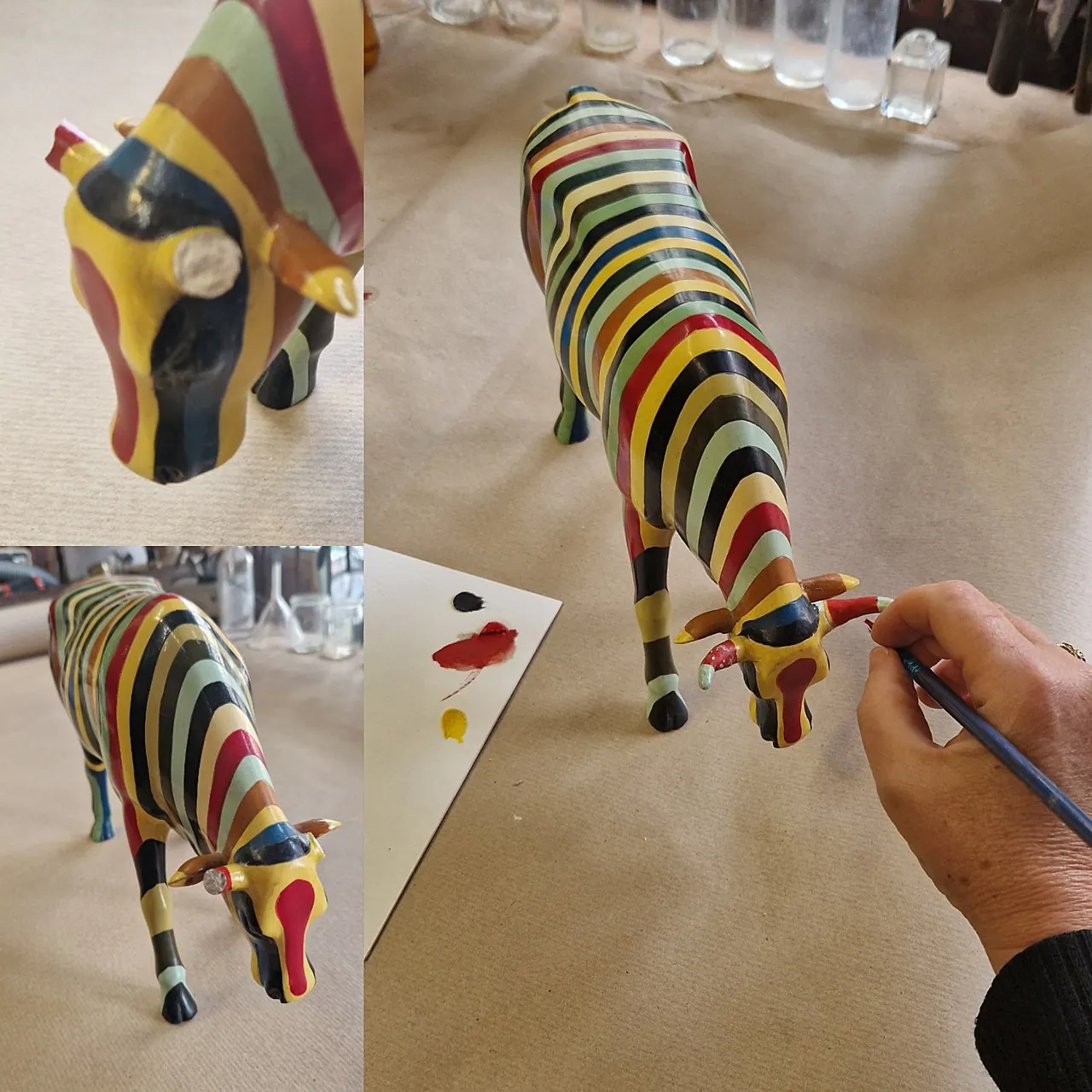
Creating the missing elements from nothingcow, painted contemporary sculpture
Missing parts
Making good the losses with a fine brush, in the studio
The cow had lost her horns: they had to be created anew.
Missing parts
Creating the missing elements from nothing — cow, painted contemporary sculpture
Creating the missing elements from nothing. The cow had no horns: they had disappeared. They therefore had to be made — modelled, fitted to the join and to the line of the head, then brought level with the surrounding surface. When the original no longer exists, this is the only possible course.
Painted contemporary sculpture. The knocks had also taken away the colour layer in patches: on flat, clean-edged areas of colour there is no texture to hide behind — an approximate retouch is seen at once.
The tones are built up on the palette until the match is exact, then laid with a fine brush within the area of loss alone, never straying onto the original paint.
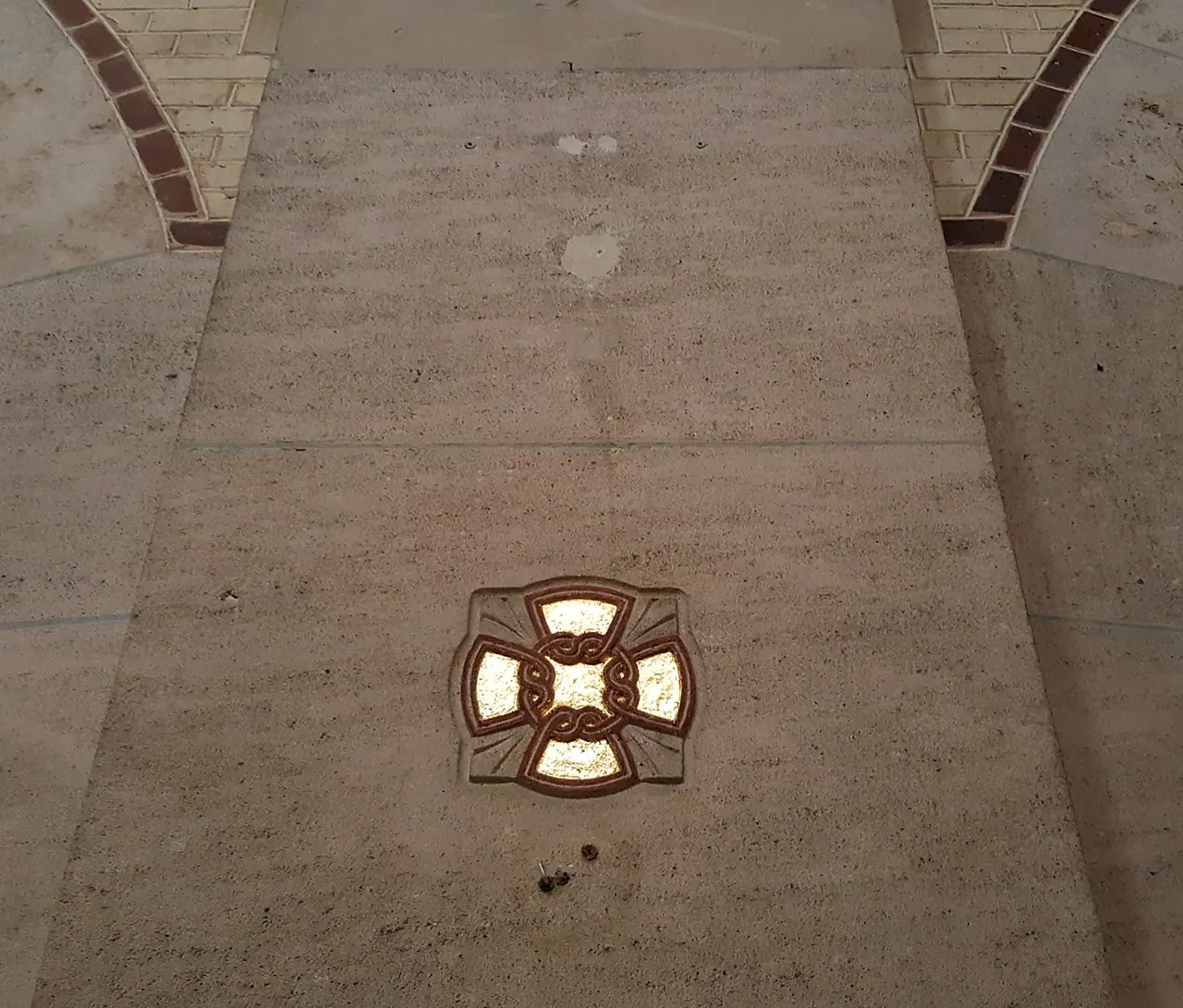
Gilding of the twelve consecration crosses with gold leafchurch of Saint-Antoine-des-Quinze-Vingts, Paris 12th
Gilding with leaf
A consecration cross after gilding with gold leaf
The cross on its pier, the nave and the chancel beyond
The twelve crosses of the dedication, taken one by one and gilded with gold leaf.
Gilding with leaf
Gold-leaf gilding of the twelve consecration crosses — church of Saint-Antoine-des-Quinze-Vingts, Paris 12th
Gilding of the twelve consecration crosses with gold leaf. The crosses are carried by the pillars of the church of Saint-Antoine-des-Quinze-Vingts, in the 12the arrondissement of Paris. Time and successive cleanings had dulled the gold and worn the outline: the cross was guessed at rather than read.
Each cross is treated in situ, in the order of the rite: cleaning and consolidation of the support, reworking of the outline and the interlace, laying of the size, then gilding with gold leaf, leaf after leaf, and finally patination to bring the new brightness into accord with the old stone.
The gold here is not an ornament: it is what makes the cross visible from the nave, and what sets it apart from the stone that carries it. Once gilded, the twelve crosses answer one another from pillar to pillar and close the space of the church — which is precisely their purpose.
Gilding with gold leaf, laying and patinationcarved wooden frame
Gilding to be renewed
Laying the gold leaf with the gilder's tip, in the studio
The final patination is what makes a repair invisible.
Gilding to be renewed
Gilding with gold leaf, laying and patination — carved wooden frame
Gilding with gold leaf. The missing ornaments — acanthus leaves, shells, bead-and-reel, ovolos — are taken by impression, fitted, rubbed down, sealed, then gilded with oil size before being patinated to bring them into chromatic unity with the old gilding that survives.
Gold leaf, copper leaf or imitation gold are chosen according to the work and to the owner's wishes. The final patination is what keeps a repair from showing: new gold left unpatinated always betrays the intervention.
Treatment of mould and micro-organismsseascape, oil on canvas
Mould and fungi
Above — before: the scattering of black spots / Below — after treatment
A scatter of black specks across the sea and the sky: the damp of the place it was kept in did the rest.
Mould and fungi
Treatment of mould and micro-organisms — seascape, oil on canvas
A painting deteriorates first of all through the place where it is kept. Damp finds its way in — a cold wall, a cellar, an attic, a room that is never aired — and a few weeks are enough for growth to become exponential. On this seascape, micro-organisms had formed a scatter of black specks across the whole of the sky and the sea, where the paint is smoothest.
The species involved are beyond counting: some 155,000 species of fungi have been described to date, out of an estimated total of 2.5 million. On historical wall paintings alone, a 2022 study recorded 260 species, belonging to 173 genera. Each feeds on whatever it finds: the glue of the ground, the binder of the paint layer, the varnish, or simply the dust settled on the surface.
The stain is never treated on its own: the whole work is treated. For a canvas, that means the reverse and the stretcher as much as the face, the ground, the paint layer and the varnish — and sometimes its removal. If the work is framed, the frame and the glazing are treated with it: to leave the wood or the reverse contaminated is to guarantee that it all begins again.
These are remedial care, carried out at the studio. They stop where preventive conservation begins, and that belongs to the owner: keeping the work away from cold walls, airing the room, avoiding sharp swings in humidity. A work that is treated and then returned to the same place will be contaminated again.
The stages of the treatment
01Condition report, examination of the face and the reverse under raking light
02Tests, then treatment of the micro-organisms across the whole work
03Treatment of the stretcher, the frame and the glass when they accompany the work
04Surface cleaning, then treatment of the varnish according to its condition
05Preventive conservation advice given with the work
Conservation and restoration in situ of a monumental paintingThe Last Supper, Saint-Joseph chapel
Large format, on site
Above — undergoing treatment / Below — after restoration
Retouching in situ, with a fine brush
A monumental work does not leave its setting: it is the studio that travels to it.
Large format, on site
In situ conservation and restoration of a monumental painting — The Last Supper, chapelle Saint-Joseph
Conservation and restoration in situ of a monumental painting. A work of this scale does not leave its setting: it is the studio that travels to it, scaffolding included.
The work begins with study. A detailed condition report; examination of the paint layer in raking light and under ultraviolet — which reveals old retouching and successive varnish campaigns — and then pigment analysis: it is this preliminary reading that determines the products, the dilutions and the order of operations.
The canvas bore tears, as well as numerous stains, scratches and tidelines. The tears were brought back edge to edge and consolidated from the reverse; the stains and tidelines treated in stages, after solubility tests; the flaking paint consolidated, the losses filled, and the colour then reintegrated with a fine brush, tone by tone, in keeping with the light of the chapel.
On surfaces of this size, the difficulty is not the gesture but the scale: every retouch must read correctly at three metres and at thirty centimetres alike. One works very close up on an image that will never be looked at closely.
The work concludes with the delivery of the restoration dossier: the initial condition report, examinations and analyses, treatments carried out, materials used and their reversibility, and photographic documentation before, during and after.
The stages of the treatment
01Condition report on site and examination under raking light and ultraviolet
02Analysis of the pigments and reactivity tests before any treatment
03Dusting, re-fixing of flaking paint, treatment of tears
04Treatment of stains, scratches and tidelines, in stages
05Filling of the losses and reintegration of the colours with a fine brush
06Delivery of the restoration dossier and the report on completion
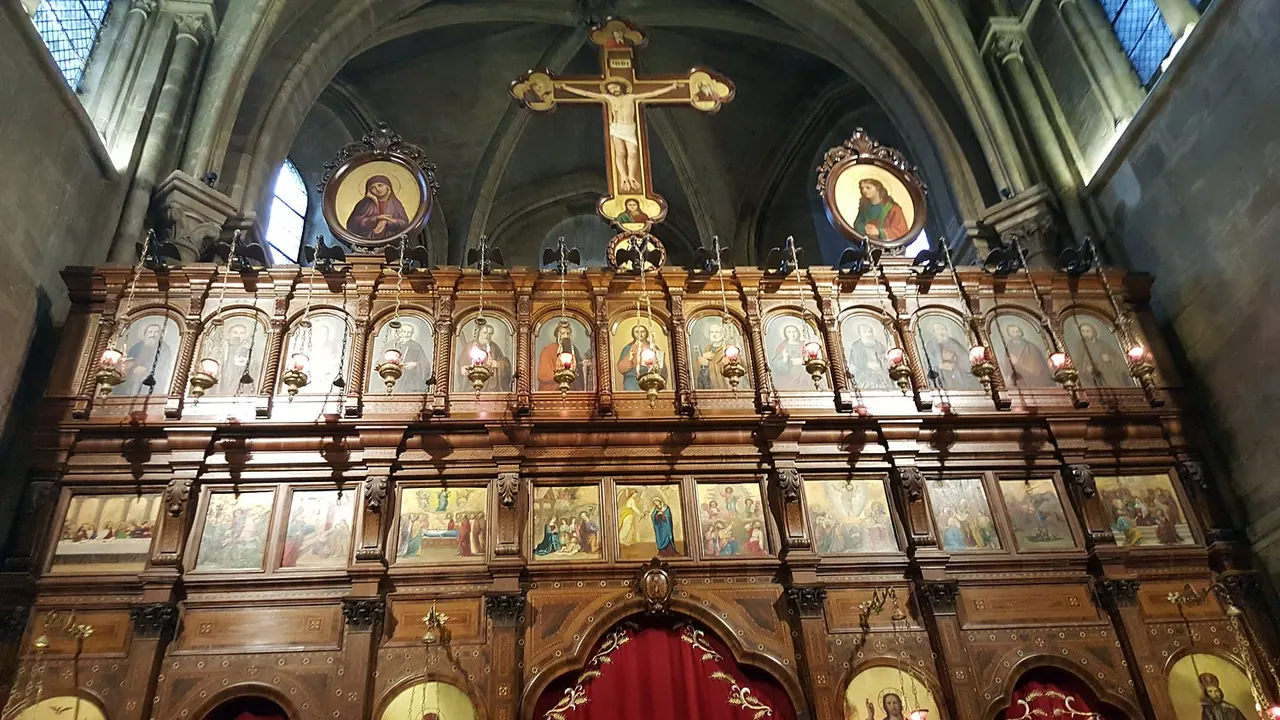
Restoration of the complete set of icons of an iconostasischurch of Saint-Julien-le-Pauvre
Complete project
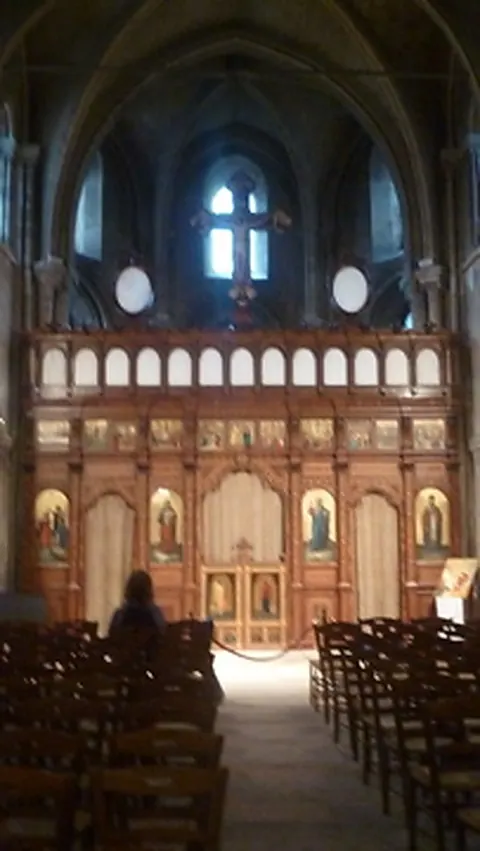
The restored iconostasis, at the lecture given at the close of the commission, church of Saint-Julien-le-Pauvre
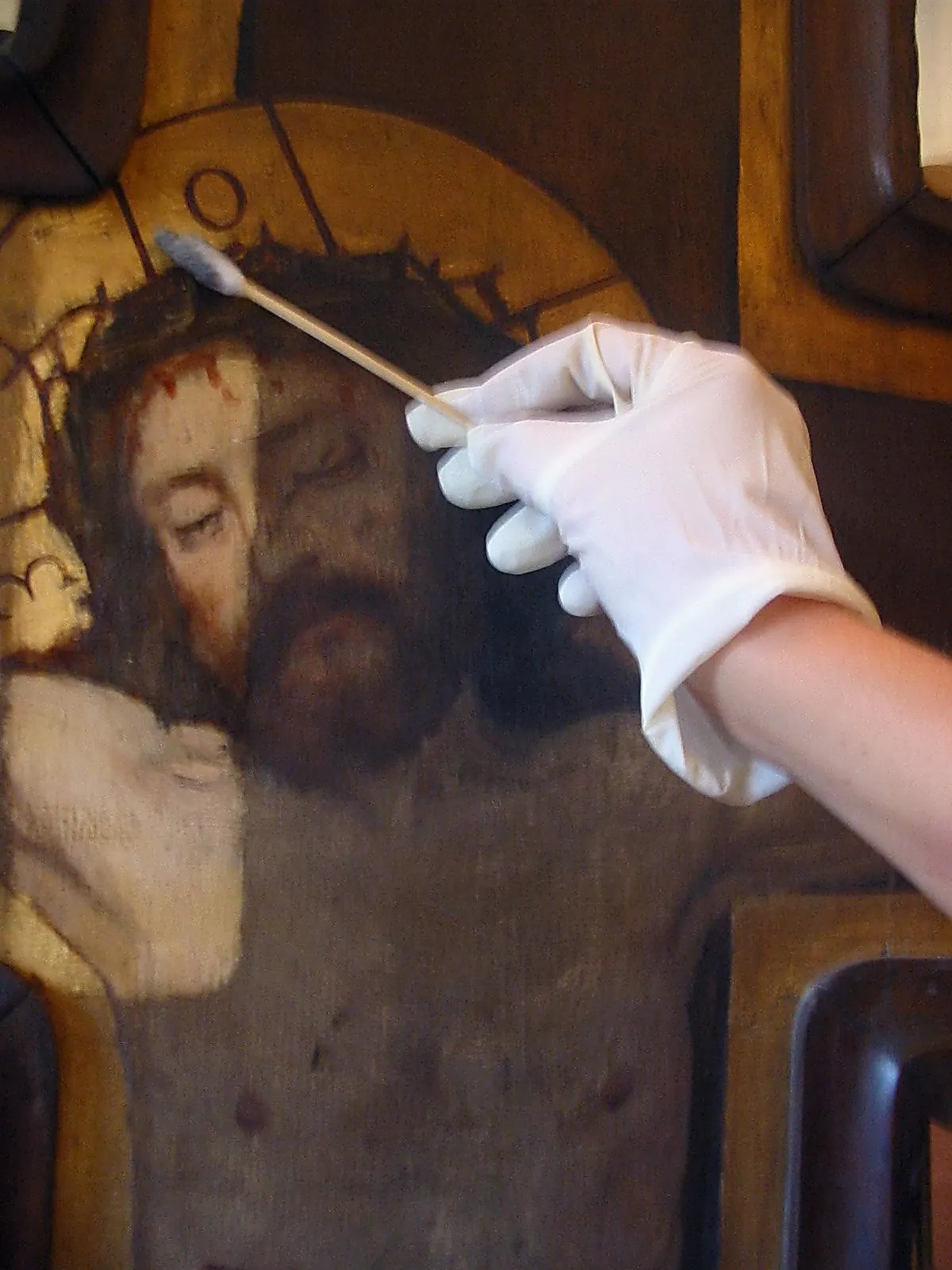
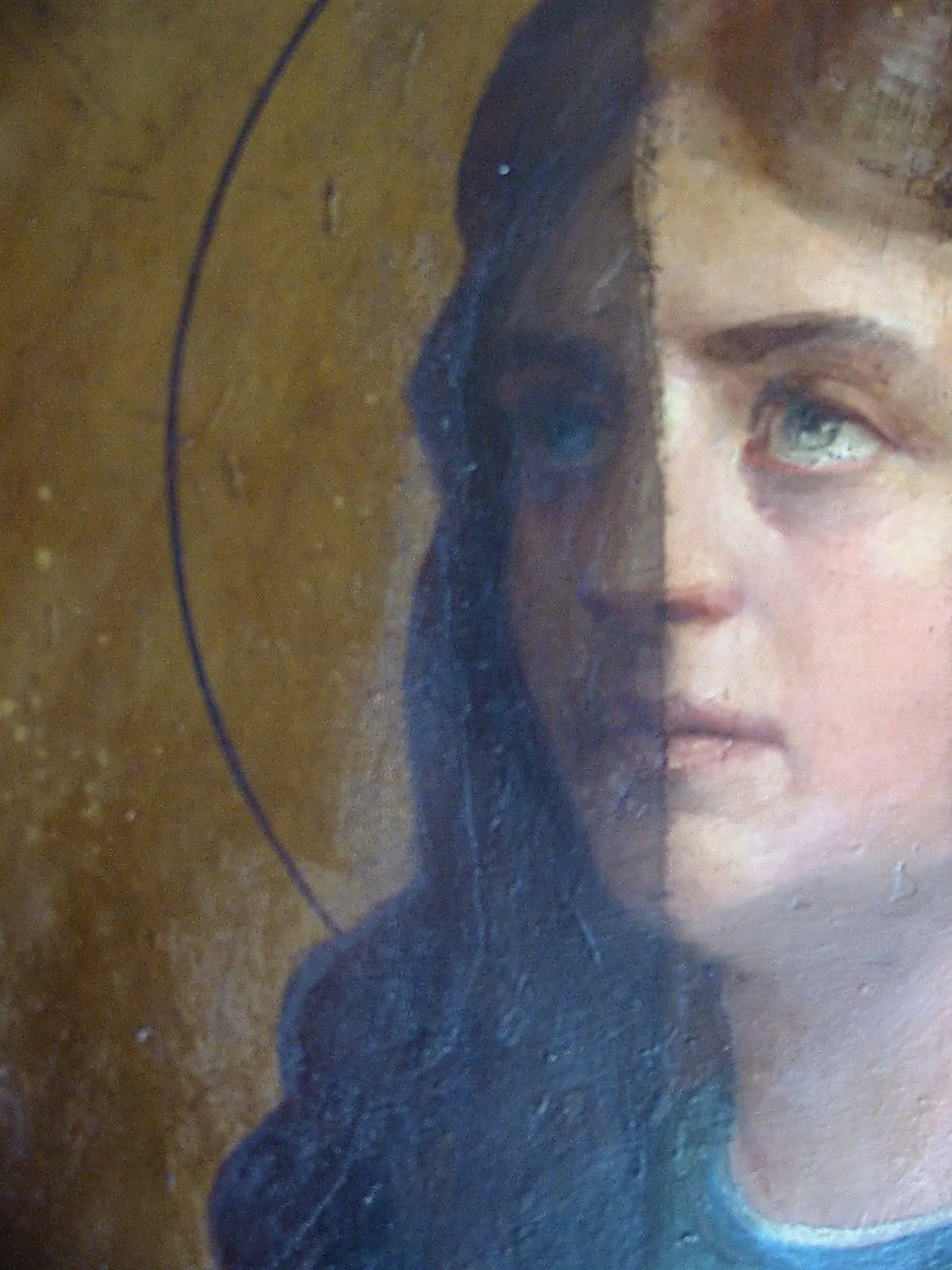
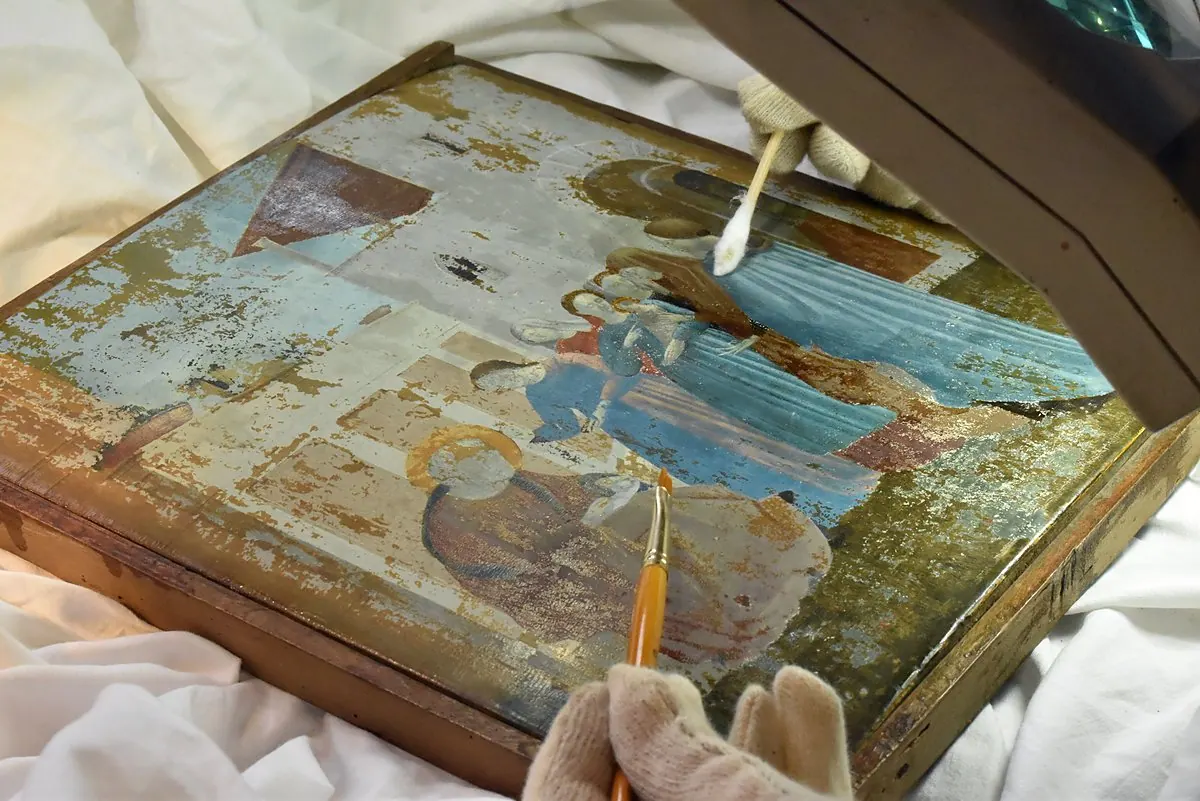
The work on scaffolding, icon by iconThe tiers back in place, after remountingThe restored iconostasis: the two tiers of icons, the cross and the medallionsCleaning test with cotton wool, on the face of ChristCleaning in progress: on the left the soiled layer, on the right the paint uncoveredGeneral view during the removal of the apostles' icons, upper tier
The entire iconostasis of the church of Saint-Julien-le-Pauvre, in Paris, restored icon by icon.
Complete project
Restoration of the complete set of icons of an iconostasis — church of Saint-Julien-le-Pauvre
Work on the complete set of icons at the church of Saint-Julien-le-Pauvre, one of the oldest churches in Paris.
The restoration of the complete set of works belonging to the iconostasis of Saint-Julien-le-Pauvre was carried out at the studio, after the works had been taken down in situ.
The condition report on the whole set of works, together with the investigations — X-radiography in particular — brought to light earlier paintings beneath the visible paint layer.
The portraits of Saint Thomas and Saint James the Greater, which had been stolen, were painted following exactly the technique and palette of Daoud Corm, the Lebanese painter of the nineteenthe century, who worked on the making of these icons.
The work was carried out in two campaigns. The first covered the lower register — the scenes from the Old Testament — together with the tondi and the figure of Christ. The second, carried out later, was devoted to the upper register, that of the apostles. The studio treated every work in the iconostasis.
The whole of the work was recorded and published in the book devoted to the iconostasis of Saint-Julien-le-Pauvre. The commission closed with a lecture, given on site, at which each treatment was presented to the public — it is that moment which the first photograph shows.
Modern paintings, contemporary paintings, marble sculpture and works on paper: treatments currently being documented photographically. The studio takes on these supports as it does the others — ask for an example.
“The art of giving back to time what it erases.”
Twenty-six years in the service of painted and sculpted heritage: old master, modern and contemporary paintings, sculpture in wood, marble, plaster and terracotta, icons, frescoes, painted schemes, gilding and frames — Paris 12th, Gare de Lyon métro.
Works by masters entrusted to the studio —Jan Van Eyck · Fra Angelico · Sandro Botticelli · Leonardo da Vinci · Michelangelo · Francisco de Zurbarán · Rembrandt van Rijn · Willem Van de Velde · Antoine Watteau · Francisco de Goya · Théodore Géricault · Antoine-Louis Barye · Honoré Daumier · Jean-Baptiste Carpeaux · Claude Monet · Odilon Redon · Suzanne Valadon · Pablo Picasso · Sonia Delaunay · Joan Miró · Alexander Calder · Jean Fautrier · Serge Poliakoff · César Baldaccini · Robert Combas
Craft
Six fields of expertise, one uncompromising standard.
Condition report, documentation before / during / after, reversibility.
01
01
Early paintings, icons & frescoes
Restoration of old master paintings, icons and frescoes using the original techniques and materials — cleaning, consolidation, illusionistic inpainting.
Ref. — Complete iconostasis, church of Saint-Julien-le-Pauvre, Paris
02
02
Modern & contemporary painting
Restoration of modern and contemporary works, street art included, with full photographic documentation at every stage of the treatment.
Ref. — Modern oils on canvas, Gentilly town hall · Artistikrezo gallery
03
03
Sculpture & works of art — marble, terracotta, plaster, wood, ceramic, ivory, spelter
Restoration of sculpture and works of art in every material — from the fragment to the monumental work.
Ref. — Marble sculpture, over 2 m, Azerbaijan Embassy · sixth-century mosaics, Karpathos (Greece)
04
04
Monumental decorative schemes & gilding
Painted schemes, ceilings and large-format canvases treated in situ, frames and high-relief stucco in gold leaf.
Ref. — 'The Last Supper', 6.15 × 2.50 m, chapelle Julien-Hénard, Paris 12th · gilded ceilings and stucco, Monceaux
05
05
Works on paper — pastels & vellum
Restoration of pastels and drawings on paper or vellum — dusting, treatment of tears and stains, re-tensioning, without ever fixing the pigment, which would alter its nature.
06
06
Mixed media
Restoration of works combining several techniques and supports, where several skills must come together on one piece.
The method
A delicate path, guided by knowledge.
To pass on, preserve and give value to our artistic heritage, combining scientific rigour, advanced instruments and craft skill.
Preserving the history of a work and weighing every gesture with precision calls for historical, scientific, technical and aesthetic knowledge, refined over many years of practice.
— Drawing up a precise condition report before any treatment.
— Carrying out analyses and reactivity tests — chemical, physical and mechanical — and then defining the method and procedures suited to the work.
— Drawing on the standard tools — raking light, magnifier and microscope, black-and-white and colour photography, ultraviolet, infrared, X-ray and scanning — and on collaboration with research laboratories and experts.
“In preserving and restoring a work of art, we become jointly responsible of an irreplaceable cultural heritage.”
The craft, in the studio
Observation and remedial careExamination and reduction under an illuminated magnifierTests and consolidationLocalised cleaning, with cotton wool and brushIllusionistic retouchingIllusionistic retouching with a fine brush
Scientific examination
Seeing beneath the paint, before touching it.
The eye, the magnifier and raking light say a great deal, but not everything. When the work calls for it, the studio undertakes a scientific examination: X-radiography, infrared, ultraviolet, and the analysis of the support and the materials. None of these techniques touches the work — each reveals a different layer, and it is that reading which decides the treatment.
—Infrared — the underdrawing, the preparatory lines and the painter's second thoughts, beneath the colour.
—Ultraviolet — old retouching, overpaint and successive varnish campaigns, invisible in daylight.
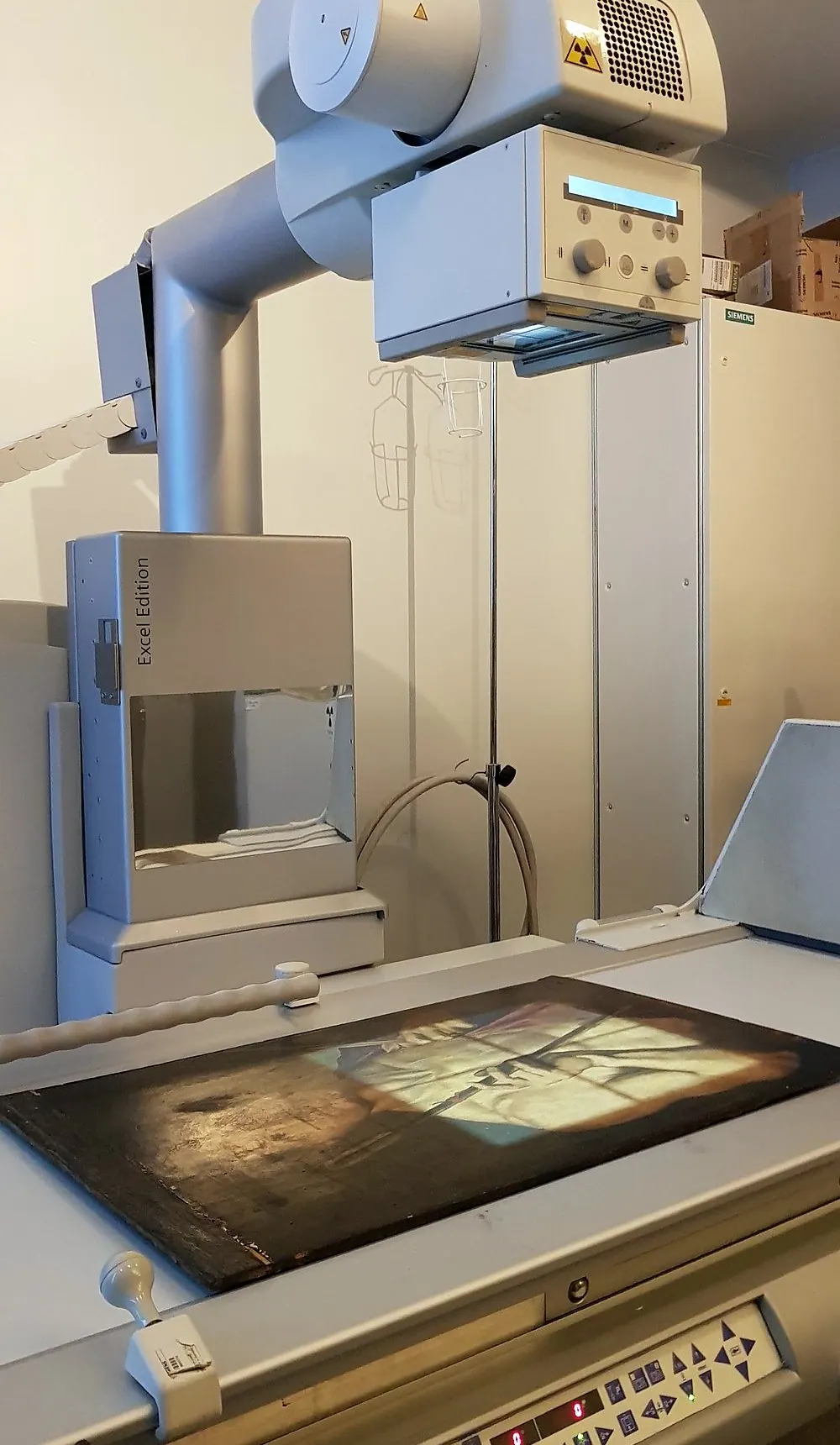
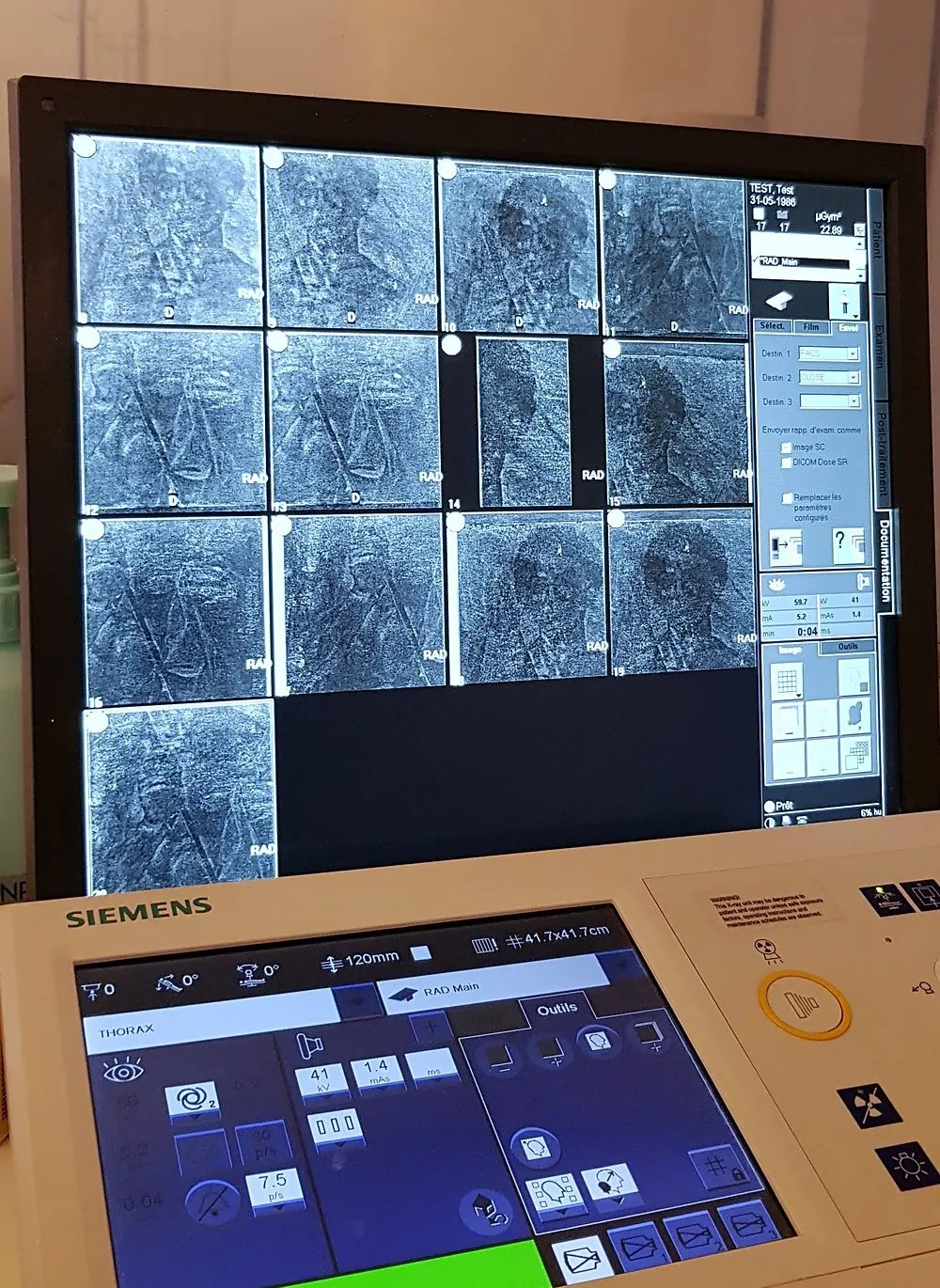
—X-radiography — the internal structure: the weave of the canvas, the stretcher and the nails, old linings, losses and fills — and sometimes an earlier composition beneath the one in view.
—Analysis of supports and materials — identification of the woods, the canvases, the binding media and the pigments, with reactivity tests before any treatment.
Such investigations are not routine: they are undertaken when they are useful and necessary — to understand an old accident, to tell the original from a past restoration, to throw light on a question of attribution, or to choose one procedure rather than another. They are carried out with laboratories and imaging teams, and their results are included in the treatment dossier handed over with the work.
The painting placed beneath the apparatus, before the radiograph is takenThe assembled plates: the weave, the stretcher and the losses appear
References
Institutions, places of worship, museums, collections.
A selection of projects carried out by the studio.
Religious institutions
Church of Saint-Julien-le-Pauvre
A complete iconostasis — the oldest church in Paris
Church of Saint-Antoine-des-Quinze-Vingts
Restoration of the sculpted copy of Michelangelo's Pietà. Gold-leaf gilding of the consecration crosses on the twelve columns of the church. Paris 12th arrondissement
Julien-Hénard chapel
“The Last Supper”, 6.15 × 2.50 m — Paris 12th
Institut Catholique de Paris
Cistercian monastery
Siena region, Italy
Public institutions
CNAM
Lumière Technology laboratory
More than ten years of collaboration, working on paintings by old masters
Fougères Museum
Emmanuel-de-La Villéon Museum
Town halls of Gentilly, La Ferté-Alais and Saint-Hilaire
Cultural centre of the Embassy of Azerbaijan
Paris — a marble sculpture more than two metres tall
Karpathos, Greece
Mosaics of the 6th century
Private institutions
Association of the Friends of Louise Barbu
Regular work over the past five years
Emmanuel de La Villéon Association
Artistikrezo gallery
Polyclinique Ney
Marouflage of a canvas by Maurice Empi, Paris
Private collections
Monceau, Paris and abroad
Damage & insurance claims
Support tailored to each work
For private owners, art transport companies and fine art logistics professionals: diagnosis of the work, condition report and treatment, from the first examination to the return of the piece.
Incidents and damage
Works damaged by flood, removal, breakage or a transport incident are taken in hand.
Insurance claim
Preparation of detailed condition reports and treatment estimates meeting the requirements of an insurance claim.
The studio in the press and in guidebooks
Guide Gallimard
Craftspeople and art crafts of Paris
The studio is among the art workshops listed in the guide.
Official directory
Art crafts directory, SEMA
Professional registration under conservation and restoration.
Regional press
La République du Centre
“Le Marché aux cerises, a historic work of art of our town, has been restored.”
Frequently asked questions
Before entrusting a work.
How much does it cost to restore a painting?
The price depends on the work, not on a scale of charges: the technique and the support, the extent of the alterations, the surface to be treated, the time and the materials required. A simple varnish reduction has nothing in common with a lining followed by reintegration. No estimate can be given from a photograph: a photograph tells you nothing of the state of the reverse, the tension of the canvas, the soundness of the paint layer, or what raking light and ultraviolet would reveal — old retouching, overpaint, incipient flaking. To quote from a photograph would be to guess, and the difference would be paid for later, by one side or the other. The work is therefore examined in person, at the studio or on site when it cannot be moved: that examination is what makes a factual and reliable assessment possible. The examination and the condition report then lead to a detailed estimate, free of charge and without obligation.
Do you carry out scientific analysis: X-ray, infrared, ultraviolet?
Yes, whenever the work calls for it. Infrared reveals the underdrawing and the painter's second thoughts; ultraviolet shows old retouching and successive varnish campaigns; X-radiography discloses the structure of the support — the weave, the stretcher, the nails, old linings, and sometimes an earlier composition. To these are added the analysis of supports and materials and solubility testing. Such examinations are not routine: they are undertaken when they are useful and necessary, with laboratories and imaging teams, and their results are included in the treatment dossier.
Can I clean an old painting myself?
No — and it is the most useful advice on this page. Breadcrumbs, a potato, soapy water, spirit, household cleaners: each of these family remedies removes, along with the dirt, part of the paint layer or the glaze — irreversibly. A varnish is not 'washed'; it is reduced in stages, after solubility tests, with solvents chosen for that particular work. A very gentle dry dusting with a soft brush is the only thing that can safely be done at home.
How does one have a painting restored in Paris?
The studio receives visitors by appointment at 28 rue Traversière, Paris 12th (Métro Gare de Lyon). The work is examined in front of you, its alterations identified, and the possible treatments explained and costed. You leave with a condition report and an estimate; nothing is begun without your agreement.
How does one choose a paintings restorer?
Ask about their training and their qualifications; insist on a written condition report and a detailed estimate; ask which materials will be used and whether they are reversible; and ask to see before-and-after photographs of comparable treatments. Ask, too, how long they have been in practice. Conservation is learnt at school, but it is formed on the works themselves: every support, every varnish, every accident encountered adds one more case to a memory that cannot be acquired in any other way. With fewer than ten years of practice, most delicate situations have been met only once or twice; beyond that, a conservator recognises before starting what another would discover along the way. The studio has been at work for twenty-six years, and has held the title of Maître Artisan for more than twelve years — a title granted precisely after years of practice. A restorer who promises to make a work 'as good as new', or who quotes a price over the telephone without having seen it, should put you on your guard.
Which works does the studio restore?
Paintings — old master, modern and contemporary — icons, frescoes and painted schemes, painting on metal and on glass, sculpture in wood, marble, plaster, terracotta, ivory and metal, ceramic and faience, pastels and works on paper, frames and gold-leaf gilding.
My painting is torn or pierced: can it be repaired?
Almost always. The edges of the tear are brought back together and consolidated from the reverse — with a non-woven patch or thread-by-thread — and the loss is then filled and inpainted. Lining is a last resort, used only when the canvas has become fragile over its whole surface. Above all, do not stick anything back yourself: adhesive tape or household glue makes treatment more difficult, and sometimes impossible.
The varnish on my painting has yellowed or blanched: what can be done?
An oxidised varnish turns brown and closes the work up; damp turns it white — this is blanching. In both cases it is reduced at the studio, in stages, after solubility tests, and never down to the paint layer. A good varnish can sometimes be kept, or even regenerated: removing it is not always the right answer.
How long does a restoration take?
From a few days for a varnish reduction to several weeks for a lining followed by reintegration. Some stages set their own pace — consolidation, a fill or a varnish must dry before the next step. The time required is given with the estimate.
Is the work reversible?
Yes. Reversibility is a founding principle of conservation: adhesives, fills, retouching and varnishes must be removable without harm to the work, so that future treatment remains entirely open. Retouching is confined to the area of loss and never laid over original material.
Do you work on site?
Yes, for works that cannot be moved: frescoes, painted ceilings, mural schemes, marouflaged paintings and large formats. The studio travels within Paris, the Île-de-France region and throughout France.
My work has been damaged: water damage, a house move, transport.
The studio takes in works damaged by flood, fire, breakage, removal or a transport incident, and prepares the detailed condition reports and treatment estimates required for an insurance claim. It works for private owners, art transport companies and fine art logistics firms.
Do you carry out valuations or appraisals of paintings?
No. Valuing a work is the province of an auctioneer or an art expert. The studio draws up a condition report — the technical and material description of the work and of its alterations — which is a different document, and one that is often asked for alongside a valuation.
How should a painting be kept at home?
Avoid direct sunlight and strong light, damp walls, the top of a fireplace or a radiator, and sudden changes of temperature. A room of even temperature, regular airing and gentle dusting: this is preventive conservation, and it spares a great many treatments.
Contact
Entrusting a work to the studio.
To prepare an estimate and to answer your questions, the studio receives you by appointment, in order to draw up a condition report and determine the treatment required. Describe your work below.